

Definition: What is Industry 5.0?
Even if not everyone is talking about it yet, Industry 5.0 - also known as the fifth industrial revolution - is no longer completely new. Back in January 2022, the European Commission published a position paper that was intended to establish Industry 5.0 as a transformative vision for Europe. According to this paper, industry should be the driving force behind the European transformation. Unfortunately, Industry 4.0 is not the right framework for this.
Et voila: Industry 5.0 is born. Of course, Industry 5.0 is essentially based on the technologies that have already been established as part of Industry 4.0. It focuses on people and topics such as resilience and sustainability. And it emphasizes how humans can work together with modern technology and AI-controlled robots or cobots to sustainably optimize work processes. To exaggerate a little: Industry 5.0 is more evolution than revolution.
Resilience, sustainability, human-centeredness -
the key points of Industry 5.0
People-centeredness
People were not completely left out of the equation in Industry 4.0 either, although the focus here was more on technology and digitalization. Industry 5.0 aims to straighten out this picture. It is now important that
- the well-being of the employee is the focus of production
- people are seen as more than just a resource or cost factor
- people should be able to make full use of their abilities
- work becomes safer, more efficient and more meaningful.
Resilience (resistance)
Today more than ever, competitiveness requires a high degree of resilience. Companies are well aware of this, but less aware of how the means of digital transformation can promote this resilience. Industry 5.0 aims to empower companies:
- Anticipate crises and derive appropriate responses and adjustments from them
- monitor and manage risks in real time.
Sustainability
Sustainability is also nothing new for manufacturing companies, but companies should become more and more aware of how far sustainability can go. Industry 5.0 therefore demands
- Respect the planet's production limits
- reduce climate damage and, ideally, avoid it altogether
- to stop "greenwashing" and achieve real positive change
- make contributions to society - for example in the context of social responsibility.

A look back in history: Industry 1.0 to 4.0
The first industrial revolution took place quite a while ago, while the fourth only began yesterday. Let's take a brief look at the history.
Industry 1.0
When? ca. 1780
What? Artisanal production was increasingly replaced by industrial production with machines powered by water and steam.
Industry 2.0
When? ca. 1870
What? Production got electricity and the assembly line. Mass production saw the light of day in the industrial world.
Industry 3.0
When? ca. 1970
What? Electronics, computers and IT systems such as the first PLC (1969) drive the automation of production.
Industry 4.0
When? since around 2010
What? Modern technologies such as AI, IoT and connectivity enable the digitalization and further automation of industry.
Industry 4.0 vs. industry 5.0: What are the differences?
A good 40 years passed between Industry 3.0 and Industry 4.0. Industry 5.0, on the other hand, was almost rapidly pushed behind after just over 12 years. How much revolution can there still be in this short time? And is Industry 5.0 perhaps more like Industry 4.1 after all? Let's take a look at the comparison.
Which technologies are attributed to Industry 5.0?
As you have probably already noticed, Industry 5.0 does not really break new technological ground - certainly not a technological quantum leap such as from manual labor to the steam engine. Instead, Industry 5.0 is a change of perspective. The focus is no longer on how colorful the brave new world of technology can be, but rather on what the entire technology can do for people. Let's take a look at this for various technologies.
Cobots
The name says it all: collaborative robots are robots that can and should work together with humans. The result is a partnership between man and machine. Partner 1, the robot, takes on dangerous, strenuous or repetitive tasks. Partner 2, the human, can take care of sensitive monitoring tasks or creative, innovative topics.

Humanoid robots
There is still some way to go here, although humanoid robots are predicted to be ready for series production by 2025 (source: Automationspraxis). Humanoid robots will resemble humans in appearance and, thanks to generative AI, will be able to observe and imitate human behavior. This opens up a wider range of applications than for traditional industrial robots.
Self-learning systems
Self-learning, AI-supported systems help employees to make decisions and can make predictions - for example, about machine failures or risks when entering hazardous areas. They can also help to avoid waste and wastage.

Augmented Reality (AR)
With augmented reality (AR), you can enhance your work instructions by including interactive elements. By mixing the digital and real worlds, you can communicate work processes much more clearly.

Virtual Reality (VR)
Virtual reality (VR) is primarily used for training and education. And these don't just have to relate to specific practical cases. You can also use VR to teach your employees overarching creativity and problem-solving skills.

Digital Twin
Your employees can be optimally trained on a virtual image of an asset, process or system without interfering with productive operations. You can also use the digital twin to promote creativity and innovation – without affecting the operational environment.
Advantages & disadvantages of Industry 5.0
What are the advantages and disadvantages of Industry 5.0? To answer this question, let's look back at the key points. You will no doubt remember: people-centricity, resilience and sustainability. Because that's what it's essentially about - regardless of whether we can now talk about an industrial revolution 5.0 or not.
Advantages
The advantages of focusing on the three core topics can be, for example
- the creation of high-quality, technologized workplaces that aim to optimize people's ability to work
- the outsourcing of repetitive tasks, for example, so that employees can concentrate on creativity and innovation - for example to develop new services and products
- increasing resilience in the company through the optimal use of technologies and "brainpower" to anticipate trends or crises
- increasing the positive impact of companies on society and the environment - in terms of sustainability and without greenwashing
Disadvantages
What disadvantages can a focus on employees, the environment and the resilience of your company actually have in return? In short: effort and costs.
- While you are still busy implementing technologies in the context of Industry 4.0, optimized machine-human interaction generates completely new expenses.
-
If you want to support your employees with cobots or train them on digital twins, you may incur significant costs for the introduction of corresponding technologies.
The big question: Is Industry 5.0 real - or not?
A lot has happened in recent years since the definition of Industry 4.0. Digitalization is progressing - despite bottlenecks and crises. At 113.6 points in 2024, the digitalization index in Germany has surpassed all previous years, with the electrical engineering, mechanical engineering and vehicle construction sector in second place in a sector comparison. Every second large company in Germany already considers itself to be highly digitalized (source: DE.DIGITAL).
And there has also been steady progress in recent years with regard to people in the context of digitalization. Companies are increasingly training their employees in digital skills. The population is becoming more digitally savvy, which means that more skilled workers with digital skills are available.
So Industry 4.0 is complete and 5.0 can begin? We can say quite clearly: no and no. Let's put it this way with the Industry 4.0 Research Advisory Board and the Industry 4.0 platform: Industry 4.0 is far from complete and Industry 5.0 builds so much on the developments of Industry 4.0 that a new terminology creates more confusion than it helps.
The European Commission itself also writes that Industry 5.0 supports and complements the current approach. What was previously lost in the technology-focused Industry 4.0, at least on paper - the reference to people, resilience and sustainability - is now officially being brought into the spotlight. Even though it has long been an integral part of many digitalization companies in practice. Without a focus on people, digitalization comes to nothing. Internalizing this is much more important than the "Industry 5.0" label.
And what about the production of the future?
"No, not another newfangled word construct." But if Industry 5.0 isn't here yet, then perhaps it will be in the production of the future. If you dismiss it as a buzzword, then you're not so wrong. Because the production of the future is actually production as it could be when it is fully digitized. In other words, the completion of Industry 4.0, so to speak. And on closer inspection, the production of the future is primarily technology-driven.
Creation of shared data rooms
Data-based production
Dynamic supply chains
Connected & climate-neutral industry
Digital guidance systems & cobots
Consistent & secure information flows
Establishment of rental models
Focusing on people today: digital worker assistance with weasl
It is not important whether you call it Industry 5.0 or Industry 4.0. What is important is that you use the tools of digitalization to create an optimal working environment in your production and thus for your employees. There are already established systems on the market that relieve and optimally support people in their tasks. One such system is our worker assistance system weasl.
weasl supports and relieves your employees at various levels:
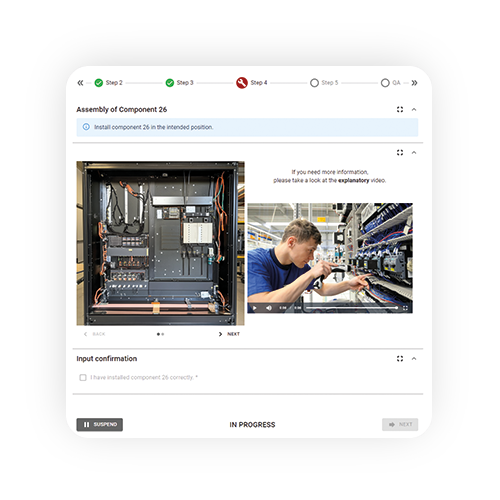
Qualification-oriented & multimedial work instructions
With weasl, you can provide your employees with all the information they need for their work - exactly when and to the extent that they need it. In this way, you avoid overwhelming your workers with a flood of information.
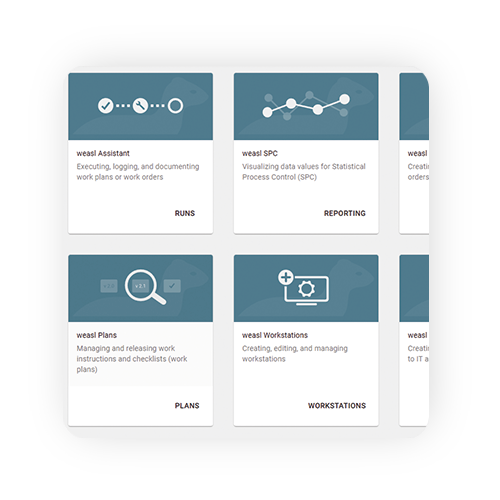
Information provision by ONE system
Your employees no longer have to gather their information from different folders, systems or storage media. weasl delivers all information and documents - exactly when they are needed.
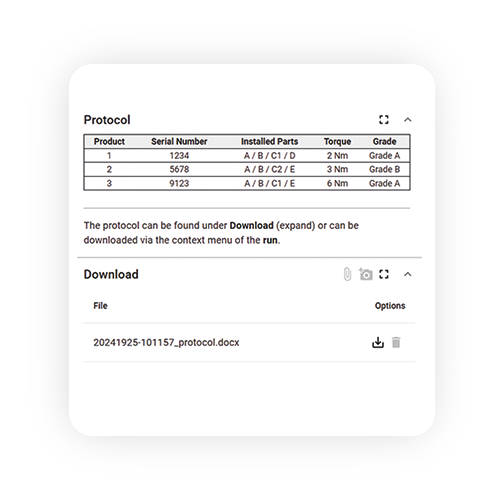
Automatic documentation of all work steps
weasl simplifies all documentation work for your employees by automatically saving all work, entries and recorded data. Your workers and fitters no longer have to worry about what has to be documented when, where and how. Weasl takes care of that.
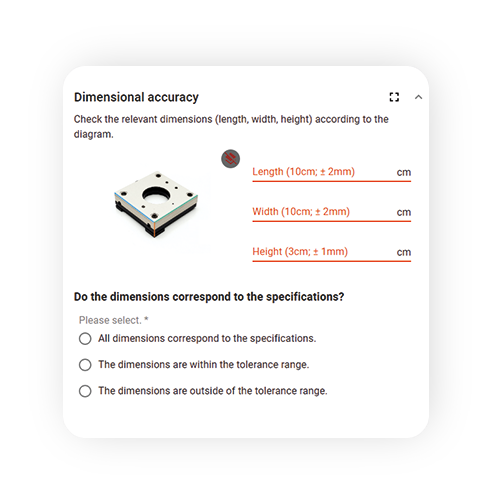
Data collection at the workstation
Walking distances are not uncommon in manufacturing companies. weasl saves your employees additional walking distances, for example to the PDA terminal, by enabling data collection directly at the workstation.
Beyond this, weasl can also promote sustainability in your production and assembly. You can read more about this in our blog post "How weasl brings more sustainability to your production".