Glossary > APQP / Advanced Product Quality Planning
APQP is a systematic process for the early quality planning of products. Before the actual production phase - i.e. during the design and development process - measures are defined to ensure the desired product quality.
This quality management has its origins in the QS 9000 standard and its successor standard IATF 16949, both of which originate from the automotive industry, but this does not mean that APQP cannot also be used in medical technology, mechanical engineering or other industries.
APQP stands for Advanced Product Quality Planning, which literally translates as advance product quality planning. In German, the term Qualitätsvorausplanung - QVP for short - is also commonly used alongside APQP.
APQP = systematic advance quality planning before the start of production
Originated in the automotive industry, can now be used across all sectors
Goal: Ensure product quality through early measures
The most important prerequisite for effective Advanced Product Quality Planning is cross-departmental cooperation. In order to plan for high product quality in advance, you need to bring the development department, production, quality assurance and supplier management together. The departments then work together to derive measures and options.
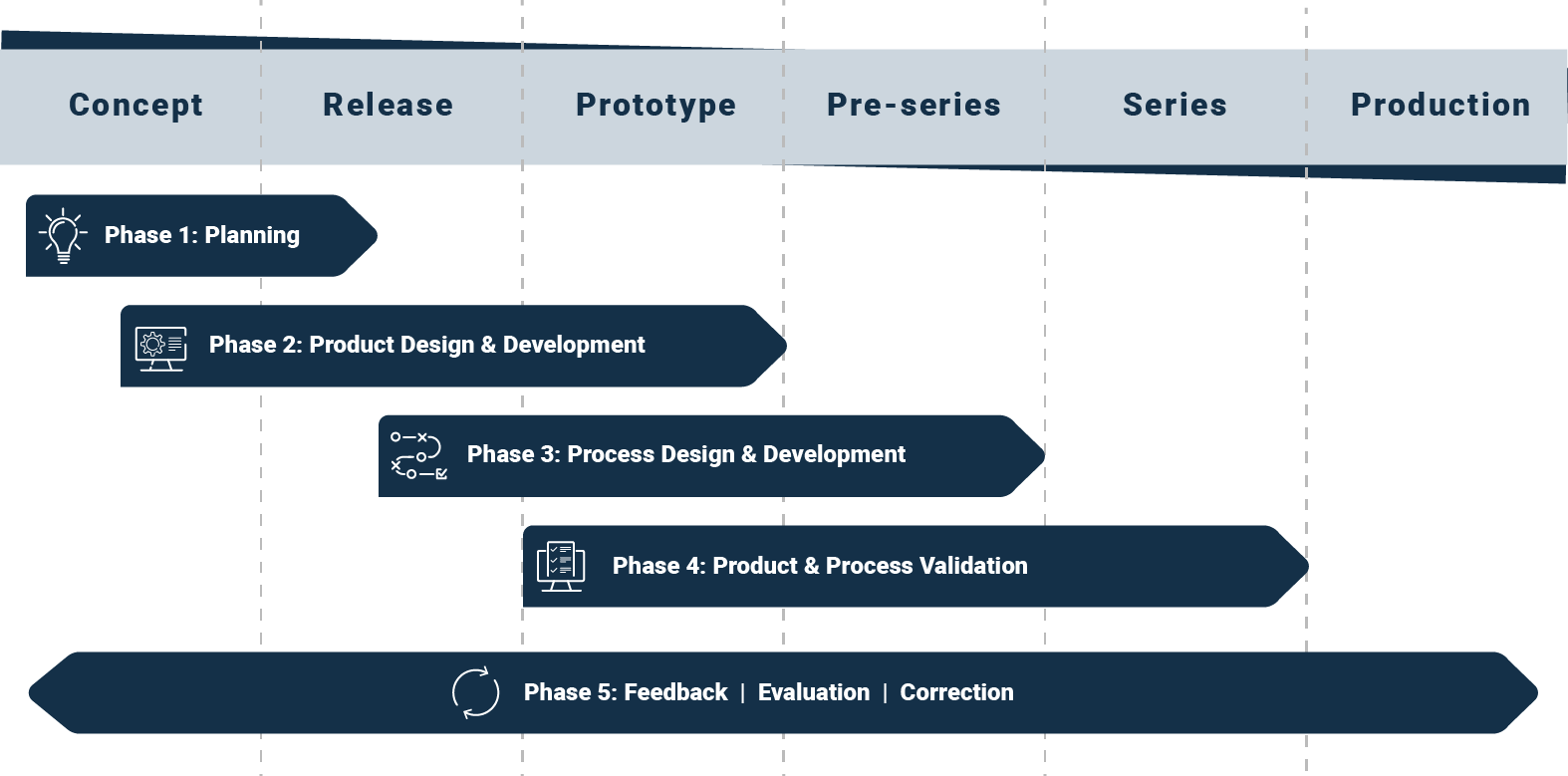
APQP processes must be carefully planned in order to achieve the desired result. And they may have to be redefined for each new order. The best way to do this is to follow the 5 phases of the APQP project structure.
This is what you need to do:
Record all customer requirements and expectations as completely and seamlessly as possible. Clarify the project requirements and framework conditions.
This is the result:
Typically, at the end of this phase, you will have specifications and concrete quality and reliability targets.
This is what needs to be done:
In this phase, the responsible departments develop a production-ready product design suitable for series production. You also plan all assembly and production processes.
This is the result:
At the end of this phase, you will have a failure mode and effects analysis (FMEA) for the design and the final product. You will have created a prototype and drawn up a production control plan.
This is what needs to be done:
You know what needs to be done. Now it's all about the "how". In phase 3, you work out efficient production processes and select the appropriate equipment, machines and systems.
This is the result:
You conclude phase 3 with a concrete process flow chart and a process FMEA.
This is what you have to do:
In this step, you validate that all theoretical and prototype preparatory work stands up to the reality of production. In other words, you ensure that the production processes deliver reproducible products according to customer specifications.
That is the result:
Typically, at the end of this phase, you will have clear reports on the success or failure of your measures.
These can include
Test equipment capability analyses
Sampling in accordance with PPAP (Production Part Approval Process)
Initial sample test reports
This is what you need to do:
You have now established an APQP process and must collect feedback on it and continuously reassess the process steps. You keep your eyes open for deviations and initiate corrective measures where necessary.
This is the result:
Over time, you optimize and stabilize the established processes more and more. Statistical process control (SPC), for example, helps you to do this.
Phase 1: Clarify customer requirements and define quality objectives
Phase 2: Develop product design ready for series production, create prototype
Phase 3: Plan production processes and create process FMEA
Phase 4: Validate product and processes under real conditions
Phase 5: Evaluate feedback and optimize processes
Important: Document and evaluate each phase separately in order to identify errors at an early stage.
Admittedly, APQP requires you to invest a considerable amount of time and "brainpower" in your production processes in advance. But the effort can be well worth it. Advanced Product Quality Planning helps you
identify and eliminate potential sources of error at an early stage
actively avoid errors instead of reworking them
establish targeted measures to avoid quality defects in series production
introduce structured planning and control processes to ensure compliance with defined quality requirements
continuously develop and optimize product quality
ensure that your products meet customer requirements and expectations
increase customer satisfaction
Early error prevention through structured planning
Sustainable quality assurance, even in series production
Higher customer satisfaction through targeted measures

Let's keep it short: the overarching aim of APQP is to identify all the necessary steps and measures required for a high-quality end product before production begins. This enables lean, error-free production processes and a high level of customer satisfaction.
Support your APQP processes by empowering your employees to work error-free at all times. Digital work instructions in weasl make it possible - and also provide you with essential insights into optimization potential.
Find out what weasl can do for your company and get our detailed product flyer.