Glossary > Check sheet

Check Sheet

weasl author Maren Fichtner
Author: Maren Fichtner | December 12, 2024

Definition: What is an check sheet?

The defect collection card - or defect collection list - is a special form of test sheet in which only attributive values are recorded. In other words, only the defects themselves are documented in writing in a defect collection card. This includes

  • the type of defect

  • the location where the error occurred

  • the error frequency

Defect collection cards are therefore usually simple tally sheets that provide a quantitative picture of the recorded defects. Physically measurable values such as weight, diameter or other production measurements are out of place here.

Defect collection cards are part of the 7 quality tools in the continuous improvement process (CIP).
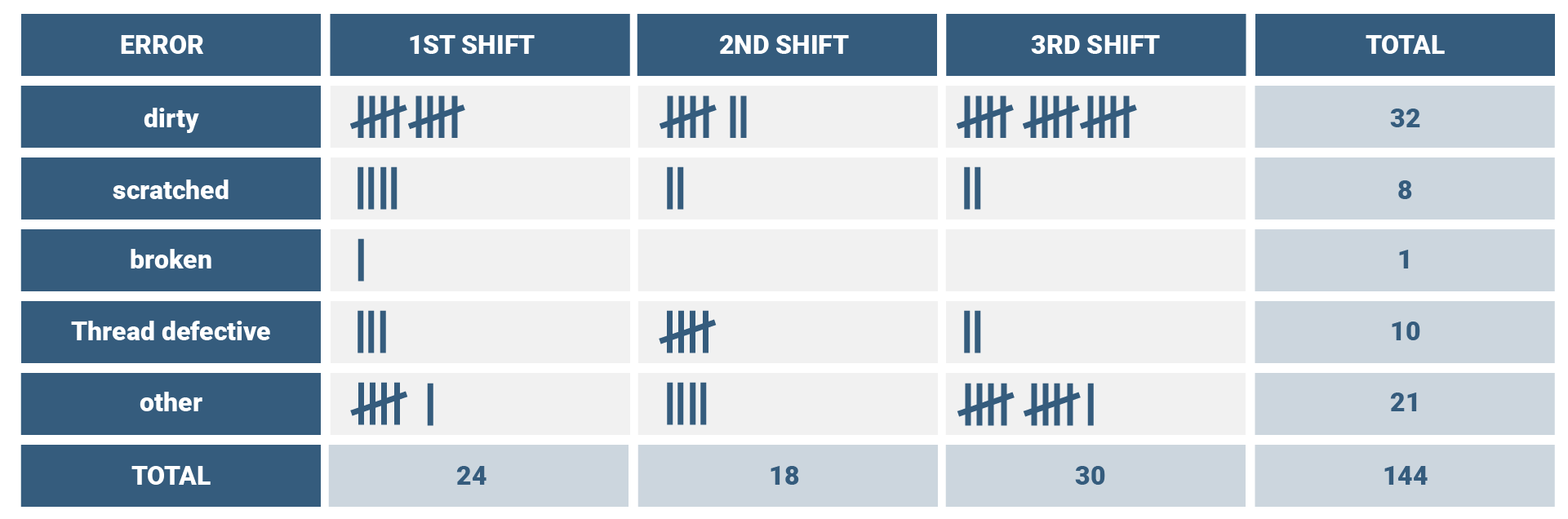

Check sheet

Use of the check sheet in production

In order to use an check sheet effectively in production, you must first create an error catalog with all possible errors that can occur in connection with a specific process or product.

It is important that the error types are clearly separated from each other so that the errors can be clearly assigned when they are recorded.

Now create a table from the error types. For example, if you want to record whether certain errors only occur in certain shifts, then write the shifts in the column header and each error type in a separate line. This way, you or your employees can document in which shift which error is made most frequently.

The check sheet should also contain information about who recorded the errors, when, where and by what means.

As this is a quality tool, you should train your employees in how to use it. If they do not know how to fill in the check sheet, errors will occur in the recording process.

Evaluate check sheet with a Pareto analysis

After the recording comes the evaluation. When evaluating the check sheet, it is best to use a Pareto analysis. To do this, list all error classes in descending order of frequency in a bar chart.

An example:

You have used your check sheet to look at the production steps in which errors occur. Step 8 of 11 has the largest bar in your Pareto chart, which means that this is where the most errors occur.

In the next step, you no longer record all errors from step 1 to 11, but consider which elements belong to step 8. All these elements become new error classes in a new check sheet.

In this way, you work your way step by step towards the causes of errors and eliminate them.

Advantages of an check sheet

Advantage: Simple recording

An check sheet is basically a tally sheet. As such, it is easy to understand and intuitive to use. The prerequisite is, of course, that the error types are clear and understandable.

Advantage: Recognize error trends

With the right categories and consistent error recording, you can identify error trends at an early stage - and counteract them before financial damage occurs.

Advantage: Visualization of data

An check sheet is a tool for data collection and visualization. Even if it has a simple design, it clearly shows where things are going wrong.

Aim of an check sheet

The aim of an check sheet is always to reduce errors. Statistical recording allows you to quickly identify the most frequent errors and work specifically on their causes.

As a result, you will always find potential for optimization and drive continuous process improvement in your company.

Avoid mistakes instead of collecting them

weasl product flyer

Don't want to keep a tally of errors? Then use our Connected Worker platform weasl to guide your employees through their jobs without errors - including checking processes, fault detection and feedback function.


Find out what weasl can do for your company and download our detailed product flyer.