
Glossary > Manual assembly
Manual assembly is a manufacturing method in which only employees and tools are used. The focus here is on people, who carry out the individual work steps by hand using suitable tools. This work includes, for example, measuring, sawing, drilling, grinding and general assembly. There is no degree of automation in manual assembly. However, this does not mean that the worker cannot be supported by appropriately optimized workstations or digital tools. In order to optimize the work processes and minimize the error rate, the employee receives support, for example, through
ergonomic workstations
computer-aided systems
smart tools
All work steps are carried out by hand - without automation.
Typical tasks include measuring, sawing, drilling, grinding and assembly.
Ergonomic workstations and smart tools support the process.
Manual assembly essentially consists of four phases: preparation, execution, quality control and completion.
The worker or fitter gathers all the necessary materials and tools and creates drawings and work instructions or searches for them in the documents. Setting up the workplace is also part of the preparation phase.
In this phase, the employee first prepares all materials. They measure material, cut it to size and shape and process components according to specified procedures. The components are then assembled and the surfaces are finished if necessary - for example by painting.
The fitter carries out visual and functional checks and re-measures the relevant parameters. If he detects deviations, the workpiece is sent for reworking.
The fitter carries out any necessary finishing work and finally a final inspection. He documents the work steps and hands the product over to the customer or the next production stage.
Preparation: prepare workplace, materials and tools, review documents
Implementation: prepare materials, process and assemble components
Quality control: visual and functional inspection, measurement, reworking if necessary
Completion: finishing work, final inspection, documentation and handover
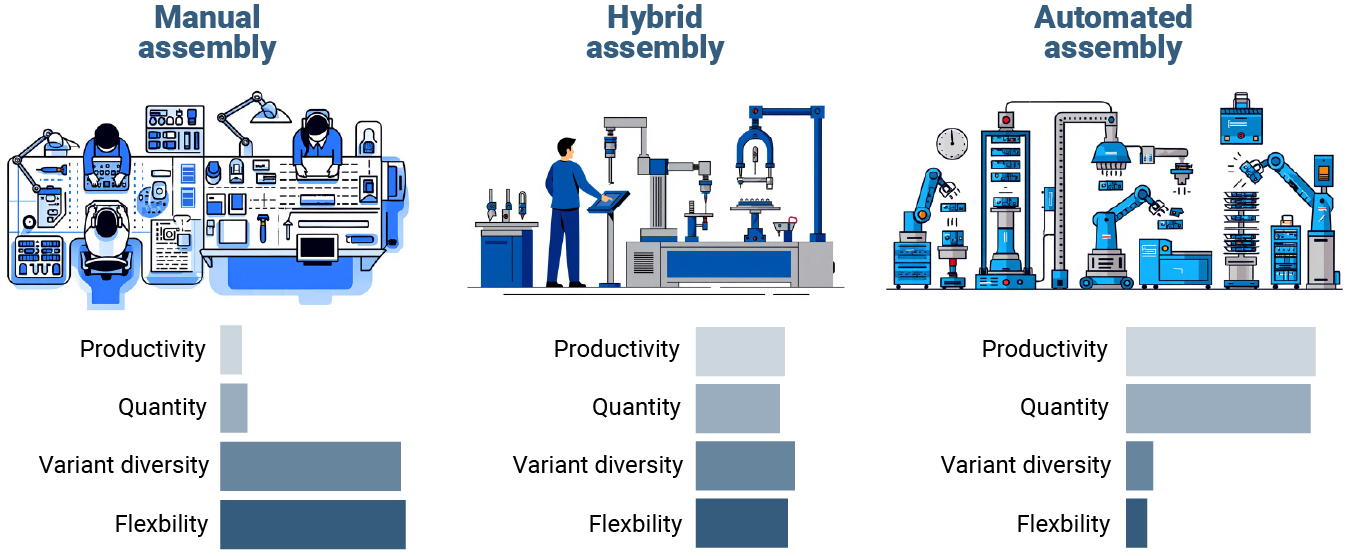
In today's production world, manual assembly seems a little out of date. Nevertheless, it can bring advantages for certain areas of your production. Manual assembly enables: more flexible personnel planning a faster response to adaptation requests the creation of new, specialized jobs the guarantee and assurance of high quality craftsmanship production with lower investments
Let's assign percentage values for the automation of the production methods. Manual assembly is at 0% automation.
The next level is semi-automated production - in other words, 50% automated production across the board. (Please note: we use the term "generalized" on purpose, as semi-automated can actually mean anything from 1 to 99%). In semi-automated production, the process flow is not yet fully autonomous. Your workers are only partially supported by the automation technology, which does not completely relieve them.
The highest level of expansion is therefore 100% automated production. Here, robots, machines and computer control systems interlock seamlessly and work properly without human involvement or intervention. Humans no longer perform any production tasks, but still take care of upstream or downstream issues such as repairs, product removal or maintenance tasks.
semi-automated: Man and machine work together; degree of automation from 1 - 99 %
Fully automated: Production is fully automated and computer-controlled
Human responsible for commissioning, monitoring and maintenance in fully automated processes

Manual assembly does not mean doing without digital support. Digital work instructions guide your workers optimally through manual assembly, facilitate quality checks and directly document all progress. You will find the ideal system for this in our Connected Worker platform weasl.
Find out what weasl can do for your company and download our detailed product flyer.