
Ensuring an efficient value creation process across all production steps
Determining requirements and coordinating materials and resources
Scheduling, capacity and cost planning incl. sequence of operations
Creation, monitoring and adaptation of documents and processes
Relief for production through decisions made in advance
Ensuring smooth processes and avoiding downtime
More transparency for costs, times and work instructions
Work planners are responsible for work planning and work control - also known as production planning and production control or production process planning and production process control.
No matter which pair of terms you come across: It is important to know that planning and control are different areas.
Work planning or production planning is upstream of control and generally comprises one-off planning measures in preparation for production. It is fundamentally concerned with three questions:
What is to be manufactured? Here, production planning clarifies which product is to be manufactured and which materials, drawings and parts lists are required for this.
How will it be manufactured? Here it must be clarified which manufacturing techniques and processes are to be used.
What will be used for production? By answering this question, production planning determines the required machines and tools.
Work planning itself can be further subdivided into workflow planning and work system planning. While workflow planning deals with the definition of specific processes and sequences, work system planning is concerned with defining the working environment - from individual workstations to the entire factory, depending on the product.
After planning comes control. In contrast to work planning, work control usually comprises regularly recurring tasks for order processing. It deals with the questions:
How much is to be produced? What target quantity is to be achieved?
When will production take place? Work control plans dates and deadlines to be met and derives from this when certain resources must be made available.
Where will production take place? Work scheduling defines which machines and/or workstations are to be used for production.
Who manufactures? Production planning also determines which employees are eligible for production based on their qualifications and authorizations.
By the way: With a digital connected worker platform, you can answer the question of qualifications in favor of all employees. Modern systems allow you to instruct your employees according to their qualifications. This means that production orders can also be processed by unskilled colleagues.
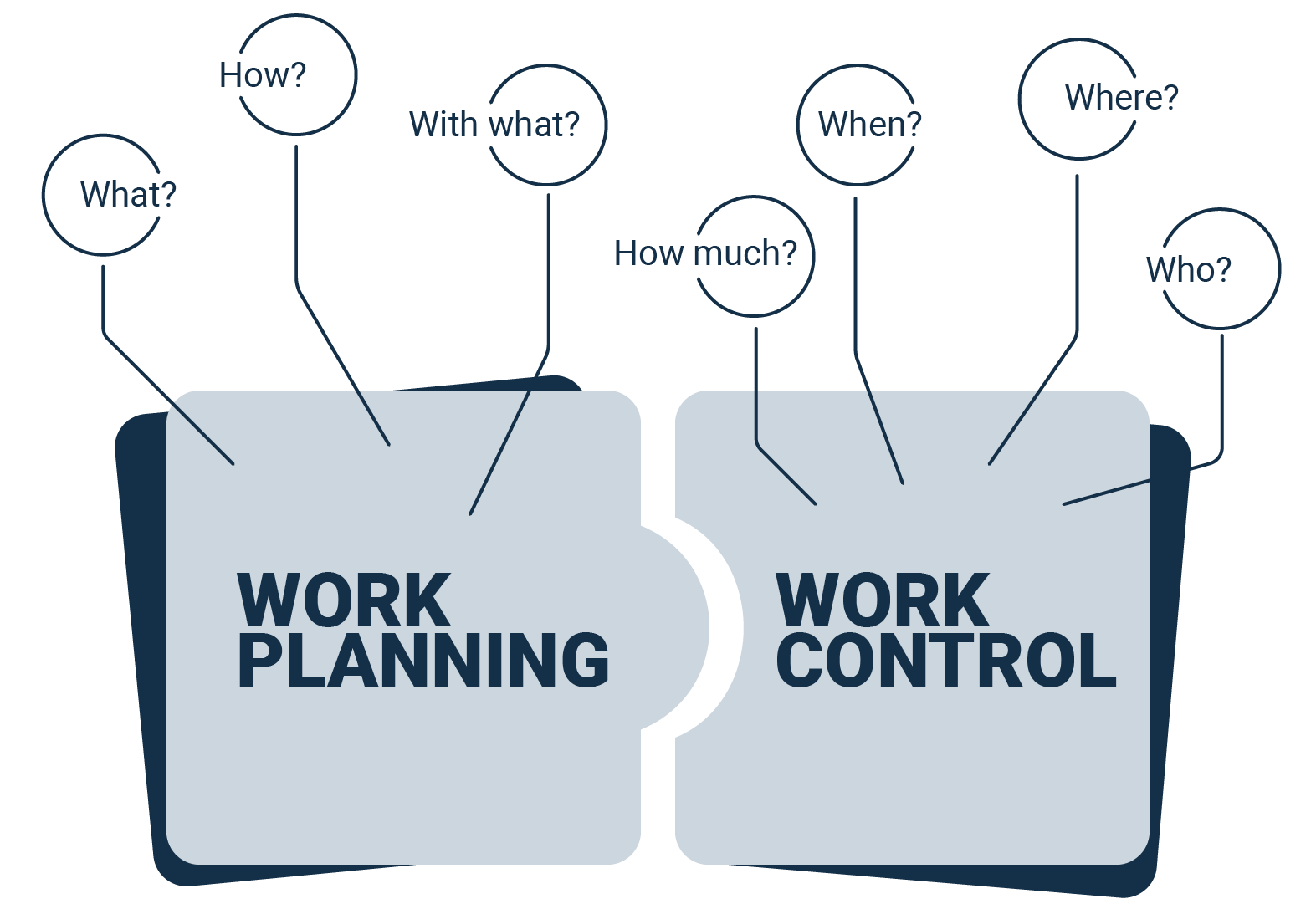
Work planning prepares production: What, how and with what is manufactured?
Workflow and work system planning define processes and the working environment.
Work control regulates implementation: How much, when, where and by whom is production carried out?
Planning = one-off preparation, control = ongoing implementation and adaptation
Digital assistance systems support skill-based guidance and flexibility.

Preparation of qualification-oriented digital work instructions, allocation of materials and parts lists, workplace management, transparent order control - with weasl you support your production planning on many levels.
Find out what weasl can do for your company and get our detailed product flyer.

GUIDE. CONNECT. EMPOWER.
weasl is the execution layer between ERP/MES and actual operations. As an AI-powered connected worker platform, weasl helps manufacturing companies execute production and assembly processes digitally, reliably, and transparently.
COMPANY
RESOURCES
GET IN TOUCH