
Glossary > Quality management
Quality management - or QM for short - encompasses all measures, management tasks and methods that serve to plan, implement, ensure, control and continuously improve processes, services or products. In a nutshell: quality management sets all the levers in motion so that a company can deliver products and services of the required quality on a permanent basis.
The practical implementation usually takes place via a quality management system (QMS), although there are no top dogs here like SAP for ERP or AWS for Cloud. The right system depends heavily on the industry, company size and requirements. For some industries, however, quality management systems (QMS) are required by law. These include
Aerospace
automotive industry
medical technology
Parts of healthcare and medical rehabilitation
Pharmaceutical and food production
There are now numerous established standards and models for the content and process design of quality management. These include, for example, ISO 9000 or the EFQM model - short for European Foundation for quality management.
Quality management ensures and improves the quality of products, services and processes
A quality management system is the practical tool for this
ISO 9000 and EFQM are common QM standards.
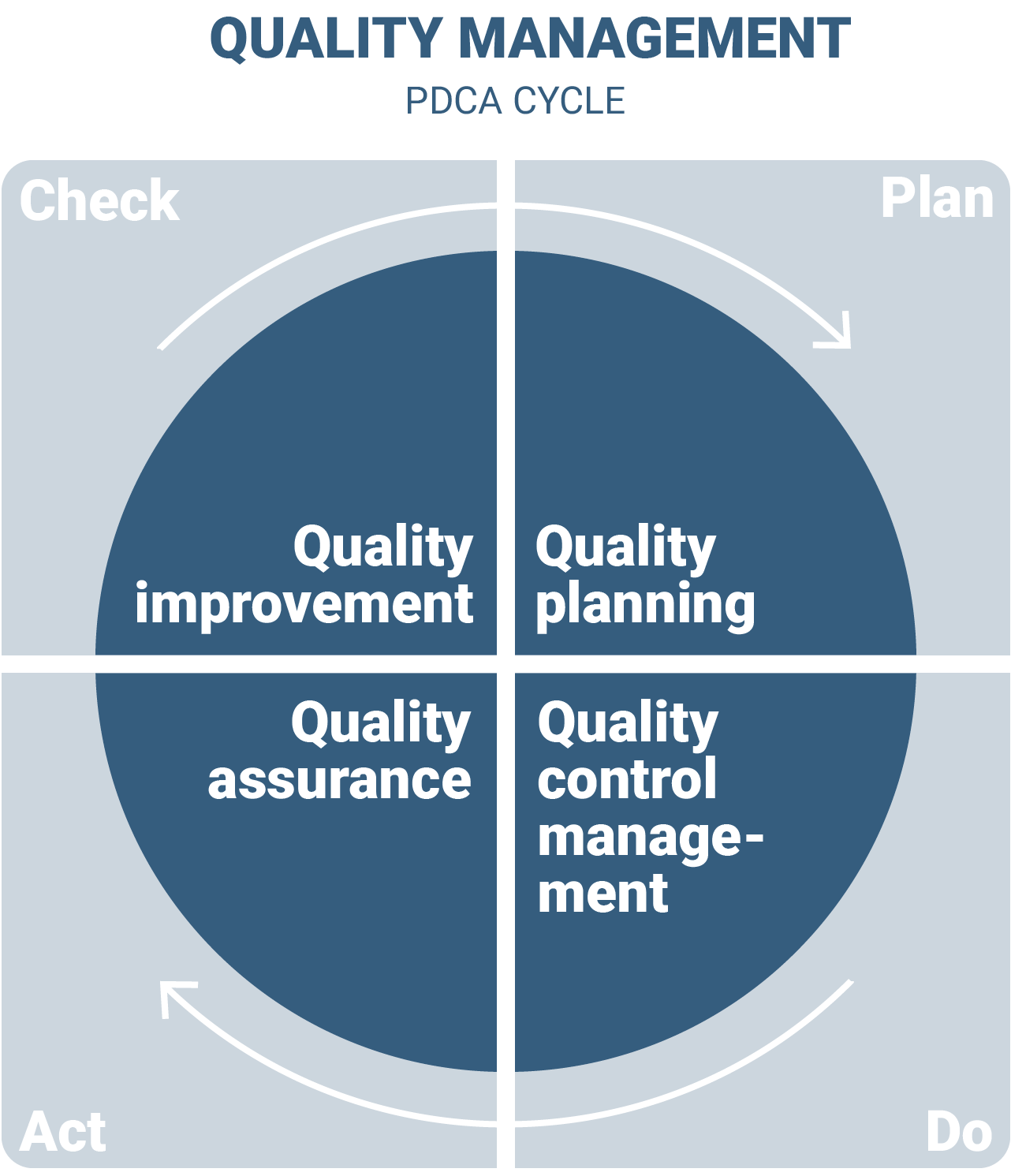
So quality management does everything it can to achieve the set quality target. Sounds like a mammoth task, but fortunately QM is not alone in this. Rather, it holds together the threads that come together from the individual sub-areas of quality management.
It all starts with a plan, which in turn is based on the current state of your company. This must first be recorded and evaluated. Once this has been done, you can derive specific measures to improve quality.
Now quality control takes over. Its task is to put the planned measures into practice and to control and monitor their implementation.
Quality assurance is already close to the actual production process. It bundles the organizational and technical measures that are necessary to ensure the required product quality.
This is followed by the practical part - quality control. Your task is to carry out tests during production or assembly. They check whether the product has been produced in accordance with the specifications and thus evaluate the product quality.
Quality Improvement collects findings from all areas and analyzes them. It derives optimizations, implements them and thus contributes to continuous improvement processes.
Quality planning: Analyzing the current status and deriving measures
Quality control: implementing, controlling and monitoring measures.
Quality assurance: bundles organizational and technical measures
Quality control: tests and assessments during production
Quality improvement: Evaluate and continuously optimize findings
Once quality management and all its components are functioning smoothly, the biggest advantage is certainly the consistently high quality that your company can ensure. However, there are also a number of side effects:
High quality means competitive quality. With effective QM, you will be able to withstand quality competition.
QM measures focus on risks and errors. And you systematically minimize these through quality management.
High quality requires structured processes and sustainable documentation. This leads to increased employee satisfaction.
An established QM ensures efficient processes that result in noticeably reduced costs.
High quality inspires your customers in the long term and strengthens customer loyalty.
Increased competitiveness and customer loyalty
Risk minimization and error prevention
Higher employee satisfaction and lower costs
Quality needs a broad basis where everything has to fit. The tasks of quality management are correspondingly diverse. They range from documents and processes to complaints. Let's take a closer look at the details:
Supplier management: Quality starts with your suppliers. You select suitable suppliers according to your criteria and objectives, evaluate them and, if possible, develop them further in line with your objectives.
Document management: Documentation is everything. Both your specifications and all necessary evidence must be documented and managed appropriately.
Test equipment management: To control quality, you need the right test equipment. And this also needs to be managed, calibrated and monitored.
Risk management: Do you know where potential risks lurk in your processes? This is exactly what you find out in risk management. You identify and evaluate risks with the help of an FMEA (Failure Mode and Effects Analysis), for example.
Knowledge management: It sounds trivial, but company-relevant knowledge must be collected, structured, maintained and made available. This is also the task of quality management.
Complaints management: It will probably never work without complaints. This makes it all the more important to have a sustainable complaints management system that handles customer complaints and complaints against suppliers and promotes the reduction of internal complaints.
Process management: With your quality goals in mind, you plan, control and optimize your company processes.
Validations and process capability studies: Are your processes running smoothly and reliably? Can processes be reproduced? Quality management also deals with these questions, their answers and the associated measures.
Improvement management: The status quo can always be improved. Continuous improvement processes (CIP) are an essential part of quality management. This also includes the management of appropriate measures - for example via CAPA (Corrective and Preventive Actions).
Management reporting: Behind all measures are key figures that must first be defined and then recorded and evaluated. The actual values can then be compared with the targets.
Auditing: The quality management system must also be regularly put to the test. You can do this through internal and external audits.
Selection of suitable suppliers and systematic documentation of all QM specifications
Risk identification and optimization of business processes
Handling customer complaints and continuous improvement processes
Management of test equipment and structured provision of knowledge
Evaluate QM key figures and carry out regular audits
So does quality management automatically lead to ever higher quality results? The answer is: No. The aim of quality management is not to constantly revamp processes and standards in order to achieve a little more quality. Rather, quality management is based on clearly defined, targeted quality objectives.
And this is precisely what QM must ensure. To this end, standards and requirements are defined in advance and quality management ensures compliance with them. Within this framework, processes and procedures are continuously optimized in order to achieve the desired quality objectives.
Ensuring defined quality targets through specifications and standards
Monitoring compliance with requirements in processes and procedures
Continuous optimization for sustainable target achievement, not for constant increase

Quality management is not possible without the very practical work of quality assurance and quality control. And you can entrust these to your employees in manual production and assembly with a clear conscience - with weasl.
Sounds appealing? Then take a look at what weasl can do - in our detailed product flyer.