
Glossary > Machine data collection (MDC)
Machine data collection - or MDC for short - refers to the collection of all data generated on a machine during production. This data can be collected, for example, via sensors attached to the machine, a PLC or an MDC or PDC terminal.
Machine data collection is also referred to as machine monitoring or machine condition monitoring.
If we look at the word alone, we could come to the conclusion: The data just needs to be captured, then it's fine. But MDC projects involve much more than just establishing connectivity for data capture.
Step 1 is, of course, connectivity - insofar as the machines are not yet able to speak. The aim is to enable access to data using sensor technology, for example.
Step 2 is data processing. Up to this point, some data has been stored somewhere in some format. Now this data needs to be made usable.
Step 3 deals with data storage - centrally and accessible to everyone. The processed data is saved for the long term and made accessible for further use.
Last but not least, Step 4 is data utilization. Here, the data is translated so that it can serve as a basis for decisions. Common methods include user- or purpose-specific evaluations or dashboard applications.
The data from your machines opens up countless opportunities for process optimization.
If you know what makes your machines tick, you will also understand when they are reaching their limits. Accordingly, you can use machine data collection to optimize your machine running times and plan maintenance processes better. In the best case scenario, downtimes can be minimized and productive times maximized. You can even derive data-based measures to optimize machine utilization from downtimes.
If sensors or your employees report a fault via a terminal, you can react immediately and also use the reported data later to analyze optimization potential.
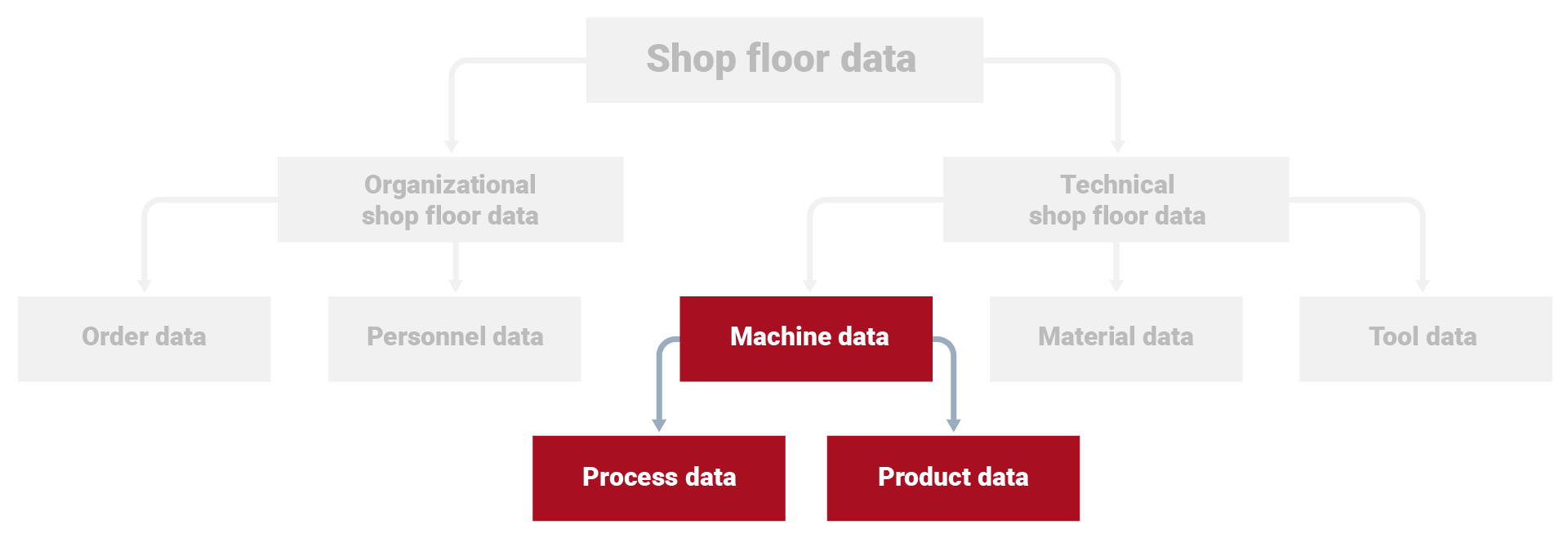
In the case of machine data, a further distinction is made between process data and product data.
Process data is all data that is required for operation or is generated during operation. This can include power consumption or pressure, for example. The aim of collecting this data is to monitor production processes - not the product itself, but the process around it.
In contrast, product data is directly related to the product - for example, quantity, dimensions or weight. You record product data in order to analyze production quality.
Other examples of data that you can collect in the course of machine data collection are
the production quantity
the number of parts
the number of rejects
capacity utilization
production times
the availabilities
the machine status
energy consumption
downtimes
set-up times
the reasons for malfunctions
Short answer: No. Even if machine data collection (MDC) is often compared with shop floor data collection, there are different areas of data collection behind it.
Store floor data collection includes both technical and organizational data that can occur in a company. And technical operating data in turn includes material data, tool data and machine data.
Machine data collection is therefore part of technical production data acquisition.
As with all data acquisition, the primary aim of machine data collection is to create transparency. Consistently recorded and comprehensibly prepared machine data provides insights into past and current machine statuses and makes forecasts possible.
In this way, machine data collection ultimately serves to monitor, control, analyze and optimize production.
Do you want to establish machine data collection in your company? Then there is usually no way around complex IIoT updates in the form of sensor technology and data analytics. However, simpler scenarios can also be implemented with our Connected Worker platform weasl. After all, your workers already collect machine data during processing.
Find out what weasl can do for your company and download our detailed product flyer.