


What is shop floor data collection?
As you are reading this text, your production is surely running, right? And on the way to the completed production order, a lot of process and status data is generated that can and should be recorded and saved. This is precisely the task of shop floor data collection. In addition, shop floor data collection creates a basis for further work with your production data. It enables:
- the correct and timely provision of data in order to plan, control, monitor or optimize production processes
- the documentation of consumption, costs and other resources and the clear allocation to originators
- answer basic production questions: Where are which products manufactured by which employees and at what cost?
What types of operating data are available?
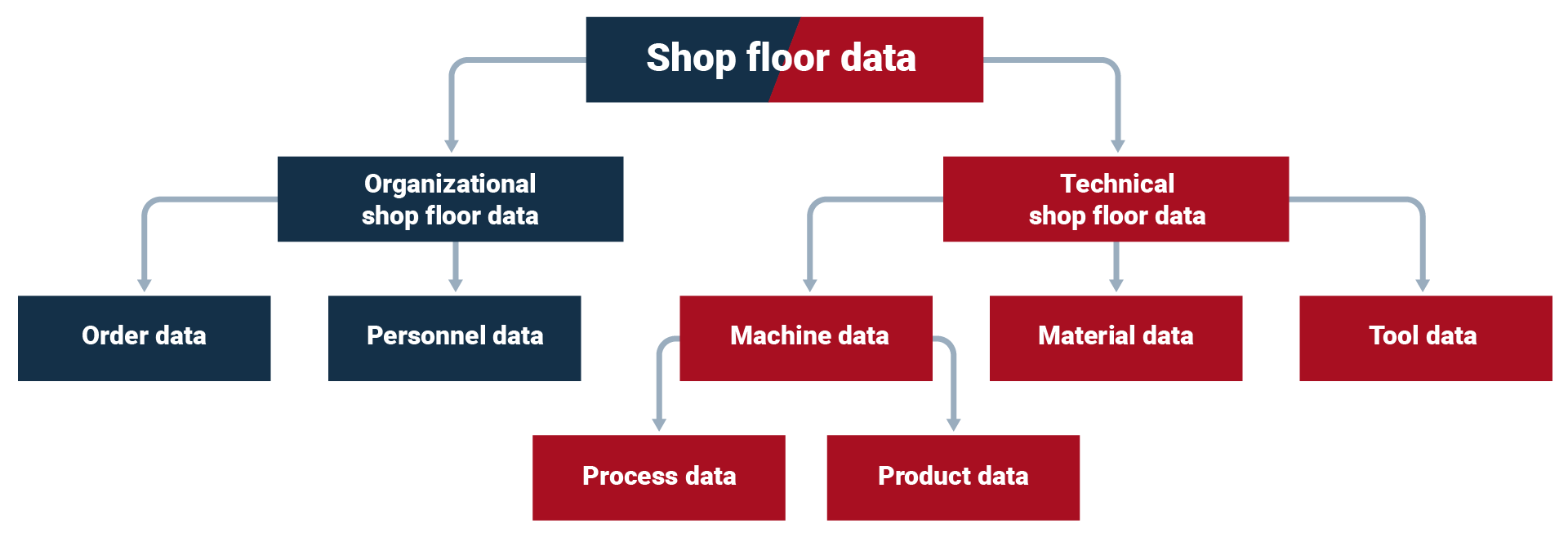
1. organizational operating data
The first block consists of organizational operating data, which in turn is divided into order data and personnel data.
Order data refers - as the name suggests - to data in connection with the production order. This can include
- quantities
- work progress,
- order status
- Order-related feedback on work processes
Accordingly, personnel data is all about data relating to your employees. This includes
- Attendances
- working hours
- access control
- Labor costs
2. Technical operating data
On the other hand, we have the large complex of technical operating data. Here we are less interested in people and orders, but rather in the machine, the material and the tools.
The recording of machine data, for example, focuses on:
- Fault messages
- interruptions
- running times
- material consumption
- Energy consumption
- Number of pieces produced
- Maintenance intervals
Machine data can be further subdivided into process data (settings, process parameters, etc.) and product data (number of parts produced, weight, etc.)
Beyond this, material data - i.e. storage locations, material stocks, etc. - and tool data - i.e. tool statuses, defects, etc. - are also relevant for shop floor data collection.

Machine data collection (MDC)
In the context of production data collection (PDC), you will often also come across machine data collection (MDC) and the question of what the difference actually is. In a nutshell, machine data collection focuses solely on data from machines and systems, while production data collection covers all operating data including machine data.
However, you can set up machine data collection as a stand-alone project if your main aim is to collect information on current machine utilization and availability in order to optimize order planning and increase productivity. You focus on the machines and therefore on recording quantities, fault messages and other machine data.
Advantages and benefits of shop floor data collection in production
Now we've talked a lot about data and data collection. Hopefully we haven't lost you in the mass of data that can be collected. Because shop floor data collection actually has one major advantage for your company: You can already benefit from the collected data in the short term. Let's take a look at the short-term and long-term benefits.
Short-term benefits of shop floor data collection
- You gain an overview of the current status of production and establish real-time monitoring. Put simply, this leads to noticeably more transparency - regarding production-related information, machine utilization and order processing status.
- You record fault messages in real time and get an immediate overview of downtimes.
- Based on the data collected, you can immediately optimize the planning of resources, personnel and orders and reduce unnecessary idle times.
- You relieve employees by having the system record operating data automatically or by direct input.
Long-term benefits of shop floor data collection
- Shop floor data collection allows you to recognize deviations in production at an early stage and initiate countermeasures promptly.
- A look at the data enables you to reliably estimate delivery times and thus ensure a high level of commitment when it comes to deadlines. This in turn increases customer satisfaction.
- The recorded data provides the qualitative basis for use in further systems. It creates the basis for basic fault analyses and can be prepared in a clear and user-friendly way, for example in the form of OEE dashboards.
- You can use the operating data collected to carry out target/actual comparisons and lay the foundations for continuous process optimization.
- With the right system, you can take an important step towards paperless production.
- Shop floor data collection enables optimized personnel planning and machine utilization. This increases productivity and reduces throughput times.
- At the very top, of course: shop floor data collection provides an important building block for securing your competitiveness.
How does shop floor data collection work in production?
Shop floor data collection is not a modern digitization phenomenon and the relevant data can only be collected if man and machine are optimally networked. But there are significant differences between the methods.

Let's just call method 1 the "old-fashioned method": Here, operating data is recorded by hand and distributed internally by hand. Of course, this still works to a certain extent today, but this method is highly prone to errors, involves a significant time lag in the processing of information and requires considerable additional effort on the part of employees. To make matters worse, some data - from the machines, for example - remains in the dark.

Method 2 is therefore the "digitized method". This is how shop floor data collection should ideally work today: Wherever possible, data is recorded digitally and (partially) automatically, for example in the form of a PDA terminal with RFID or barcode recognition, through sensors and gateways on machines or through mobile data recording with mobile scanners or similar.
This minimizes the risk of errors. Your employees also have the option of entering data manually at recording stations, PDA terminals or in corresponding PDA software on their work devices. This enables structured and systematic data collection in real time and completes the pool of recorded data.
Tackling shop floor data collection with a PDC system
As you can see, modern shop floor data collection is not possible without a technical basis. To approach the topic, you can therefore introduce a PDC system in your production. Such a PDC system consists of hardware such as a PDC terminal, appropriate software for shop floor data collection and the necessary infrastructure for recording, displaying and evaluating all relevant production data.
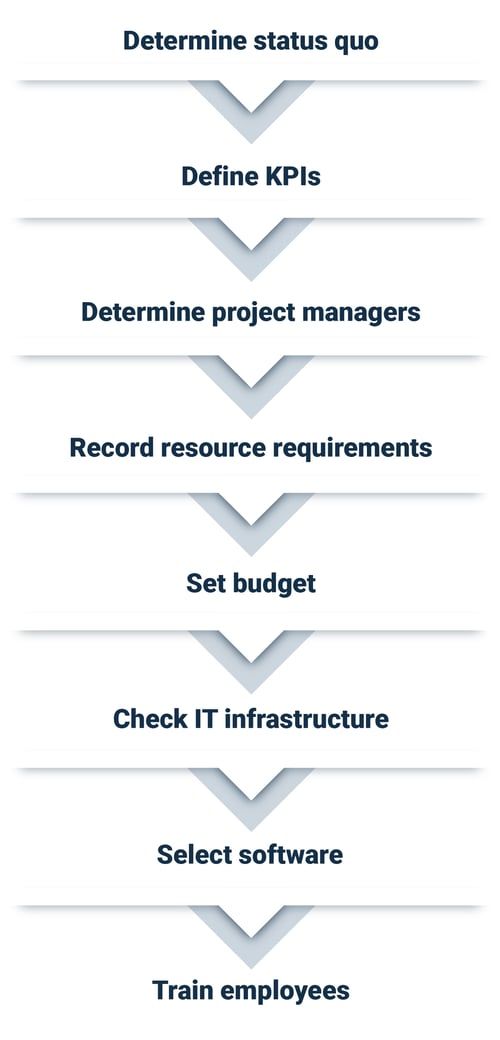
But before you select such a system, you should clarify the basics.
- Determine the status quo: What data is already being recorded? Is this data sufficient?
- Define KPIs: Which KPIs help to optimize production and should be recorded accordingly?
- Determine the person(s) responsible for the project: Who will benefit directly? Who can effectively drive the project forward?
- Record the need for resources: Is additional hardware required? If so, which ones?
- Define a budget: What can you spend? How much can you save with the system and over what period of time?
- Check the connectivity to the existing IT infrastructure: Which interfaces are required?
- Select suitable PDA software: What does the software need to do? Which functions are essential
- Train the employees: Why does the system exist? How does it help? How is it operated?
Selection criteria for future-proof PDA software
The selection of future-proof PDC software plays a particularly important role. The PDA system or PDA terminal can only be as good as the software that works in it. And in the best case, the selected software for shop floor data collection can even be used outside the system and on other end devices. Therefore, make sure that the PDA software
- Simple installation or easy access, e.g. via SaaS
- Flexibility and modularity in order to be able to react quickly to changing requirements
- the use of the latest technologies
- comprehensive security measures, such as data encryption and access control
- optimal connectivity thanks to an open system with open interfaces
- High level of user-friendliness and intuitive operation
- usability on stationary AND mobile devices
- Compatibility with the selected hardware
Ever thought about it? weasl as PDA software for simple scenarios
You have now read about the quantities of data that can and should be collected as part of shop floor data collection. And that PDA systems can provide a powerful, but certainly also quite large-scale answer to your data questions. We would like to suggest an intermediate step that is particularly useful when it comes to collecting operating data during manual production processes. When your workers process work orders, they inevitably generate data. This data can be comprehensively recorded and used profitably with a modern worker assistance system.
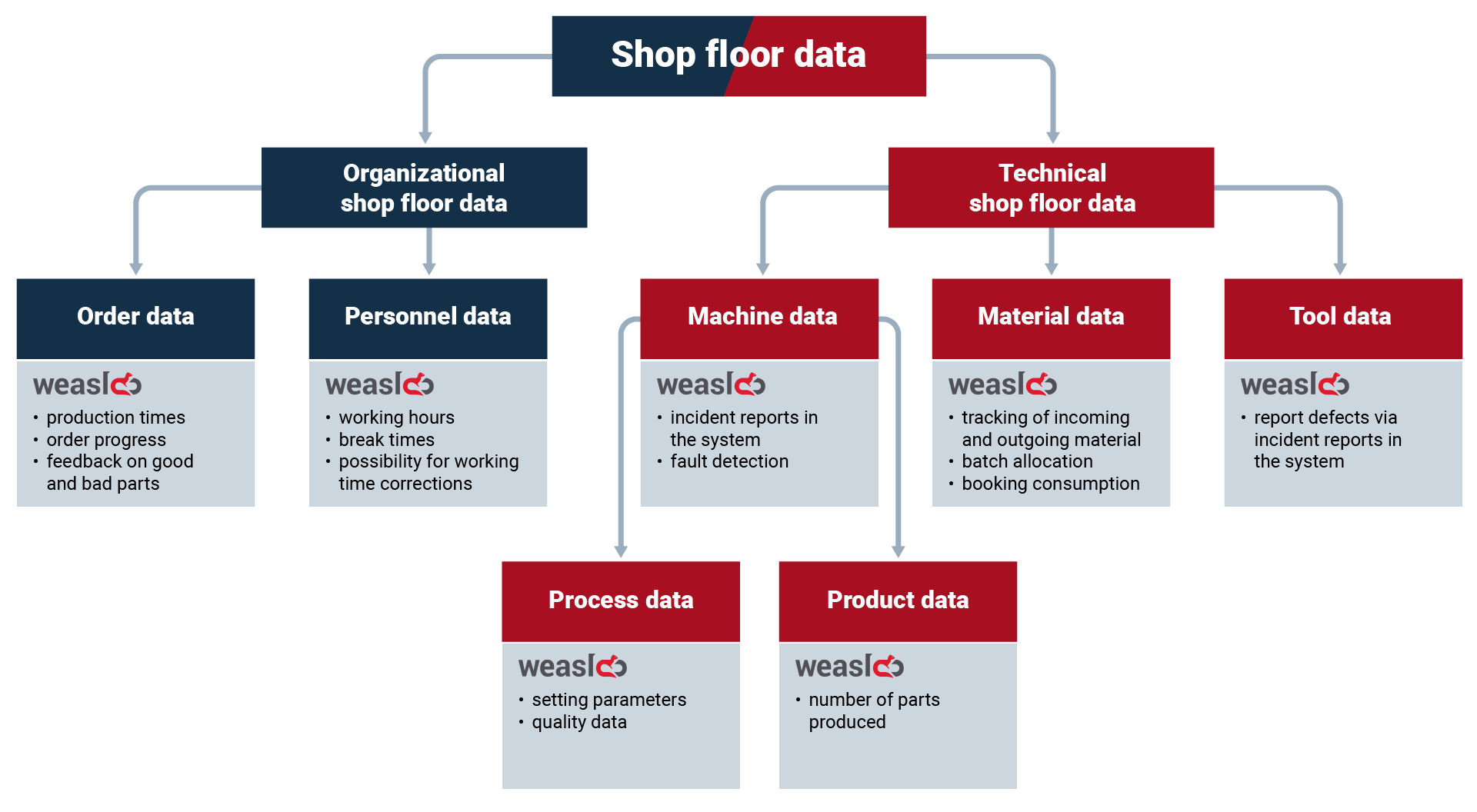
Our worker assistance system weasl combines key features from both worlds: For your workers, the system brings access to current work instructions and order-related information, while at the same time offering numerous basic functionalities for shop floor data collection. During manual production, your employees can record relevant operating data in the following areas:
- Order data such as productive times, work order progress or order-related feedback on good and bad parts produced.
- Personnel data such as working hours and break times. Working time corrections can also be made.
- Machine data, e.g. in the form of malfunction recording by reporting an incident directly in weasl
- Process data in the form of setting parameters and quality data
- Product data in the form of the number of parts produced
- Tool data in the form of reporting defects directly in the worker assistance system
- Material data through the tracking of incoming and outgoing materials, batch assignments or the recording of consumption
All this data is recorded digitally directly in the system that your workers also use for processing. In addition, the recorded data is immediately available for further processing, transfer to leading systems and detailed evaluation.
PDA software in comparison: solutions for shop floor data collection
Shop floor data collection does not always have to be synonymous with large, expensive software solutions. Basically, you are spoiled for choice as to whether you opt for standard software, individual software or a worker assistance system such as weasl. Your specific requirements and goals determine the solution. The following table is intended to provide you with a small decision-making aid.
How can operating data be used further?
Operating data can only be really effective if it is used consistently and effectively. This applies to data preparation as well as visualization and evaluation. It is therefore important to connect the PDA system or the PDA software to other systems. These can be
- Production planning and production control systems (PPS)
- Plant Information Management Systems (PIMS)
- Warehouse management systems (WMS)
- Enterprise resource planning systems (ERP)
- Manufacturing Execution Systems (MES)
- Supervisory Control and Data Acquisition Systems (SCADA)
If you have one of these systems in use in your company, plan the integration with your new solution for shop floor data collection. This will pave the way for data-based decisions, for example for detailed production planning. The more data can be recorded in real time and processed immediately, the more reliable statements and forecasts become.
Quo vadis, PDA: trends in shop floor data collection
In an increasingly digitalized production environment, solutions can and should no longer be regarded as isolated islands that are only intended for their actual purpose. In the case of PDA software, this is actually ruled out from the outset and yet further trends are also emerging here.

Analysis of production data through the use of AI and machine learning for early anomaly detection

Training with VR/AR to illustrate where and how data is recorded during set-up or tool changes, for example

Increasing cybersecurity requirements and regular review of the security measures of the PDC

Monitoring and reduction of energy consumption and other resources as well as waste reduction based on the evaluation of production data

New solution approaches in the software itself, for example through no-code/low-code or cloud migration
FAQs: Frequently asked questions about shop floor data collection