
Glossary > Set-up time
The set-up time is the time required to prepare and return a work system - for example a machine, a system or a piece of equipment - before and after the order is executed.
REFA abbreviates the set-up time with the time typetr. Together with the execution timeta, it results in the order time T.
Set-up times are downtimes during which no added value is created. Accordingly, they have an impact on your productivity. The longer a machine or system has to be set up, the more value-adding working time you lose.
Time for preparation and return of machines before/after a job
Part of the order time, but does not cause any direct added value
Long set-up times reduce productivity due to machine downtime
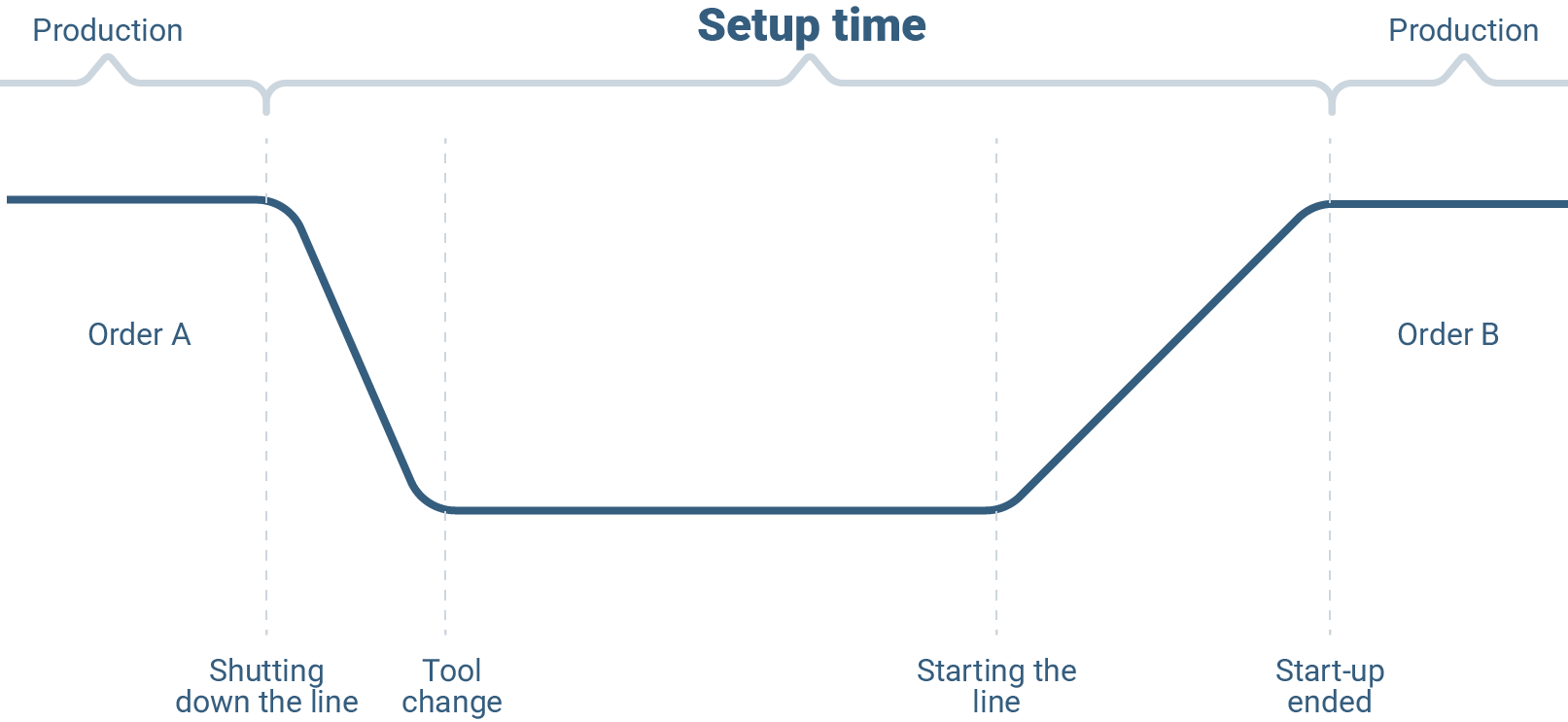
During the set-up time, everything necessary for a work order is prepared - or reworked to enable set-up for the next order. This enables the machine or worker to start adding value without delay or further preparation.
For example
a tool change is carried out in the machine
the system is checked for functionality before the start of production
a new setting or adjustment of machine parameters is carried out
an assembly workstation is prepared or tidied up
The set-up time is made up of three components. Firstly, there is the basic set-up time. This is the actual working time that an employee needs to set up a machine. Then there is the set-up distribution time. This is reflected in a percentage time surcharge for unplanned interruptions such as tool searches or consultations. The third component is the set-up recovery time - also a percentage time surcharge that takes into account the recovery phase after physically and mentally demanding set-up work.
These three components result in a very simple calculation:
Set-up time = basic set-up time + set-up distribution time + set-up recovery time
Let's take a look at an example. Your employee needs 40 minutes to get a machine ready for operation. This is the basic set-up time. In your experience, unplanned interruptions account for another 5 percent of the basic set-up time, i.e. 2 minutes. Allow 10 percent of the basic set-up time for the set-up recovery time, i.e. 4 minutes.
This results in the following calculation: set-up time = 40 minutes + 2 minutes + 4 minutes. Ultimately, the set-up time for this one machine in our example is 46 minutes.
In order to be able to calculate a set-up time adequately, you should record and evaluate the data of the set-up processes. In this way, you can quickly calculate average values that are close to the actual set-up times. This will ultimately save you valuable time.
Set-up time = basic set-up time + set-up distribution time + set-up recovery time
Distribution and recovery times are added to the basic time as a percentage
Data acquisition of set-up processes helps to determine realistic average values and save time
You can't do without set-up times. The more varied production becomes, the more important it is to optimize set-up times to the necessary minimum. The more efficient the set-up process, the less downtime you have to record and the faster your employees can get on with their value-adding activities.
Minimizing set-up times is the order of the day. And fortunately, there are already some tried and tested methods for doing so.
Single-Minute Exchange of Die means something like "tool change in the single-digit minute range". In general terms, this means that the changeover time from the last part of a batch to the first part of the next batch should be in the single-digit minute range.
To achieve this, internal and external set-up processes are first separated. While the machine has to be at a standstill for internal processes, it can continue to run for external processes. Where possible, internal set-up processes are transferred to external set-up processes and both types of process are then optimized and standardized. The aim is to achieve set-up times of minutes instead of hours.
A second way to minimize set-up times is to modernize your technical framework. In many cases, certain set-up processes can already be replaced by automated processes. Predefined machine programs can be processed independently by modern or modernized machines and thus support upstream or downstream set-up processes.
There is also great potential in digitalization. Modern software solutions, from digital production planning to worker assistance systems, support your employees on the path to optimal set-up processes.
Reducing set-up times increases efficiency in multi-variant production
SMED separates internal from external set-up processes and shortens changeover times
Automation and digitalization speed up set-up processes

Save your workers from confusion and time-consuming queries during set-up processes. Provide them with meaningful digital work instructions that help them reach their goal quickly and without errors. Our connected worker platform weasl makes it possible.
Sounds appealing? Then take a look at what weasl can do - in our detailed product flyer.