




Industry 5.0: The Future of Manufacturing, or Just Another Buzzword?
Paperless manufacturing: What does the status quo look like?
When it comes to paperless manufacturing, dramatic scenarios of barely manageable masses of paper and impenetrable paperwork are often painted. However, we can say from experience that things haven't looked that dramatic in most companies for a while now.
However, some relevant processes are still paper-based and therefore incompatible with the requirements of digitization. Not to mention that paper-based processes always mean more time and effort and entail a higher risk of errors and loss of information.
In concrete terms, you will often still find paper in production
- in the form of work instructions and bills of materials
- in operating instructions and design drawings
- in routing slips
-
in accompanying documents and delivery notes
- and, somewhat more abstractly, in the form of store floor boards.
The disadvantages in production are the same as with any analog, i.e. paper-based, information carrier:
- If you want to transfer information and data - be it to another sheet of paper or, in the best case, to a digital system such as an ERP - then this can only be done manually and with noticeable effort.
- New versions of the same document can be in circulation at the same time as the old ones and it is difficult to ensure that your employees are always working with the latest version.
- At the end of the shift, several copies of the same document with different processing statuses are in circulation - goodbye sustainability.
Paperless manufacturing in figures
Let's get a little more specific and take a look at a recent study on paperless manufacturing. In the Digital Office Index 2024, Bitkom analysed the digitalization of business and administrative processes in German companies. And even if the overall corporate processes are considered here and non-manufacturing sectors were also surveyed: The results provide a clear overview. This is the state of paperless processes in companies:
The study shows what we already suspected: The paper deserts no longer exist, but there is still considerable potential in processes that are still paper-based.Source: Bitkom Digital Office Index 2024
What is the goal of paperless manufacturing ?
The goal of paperless manufacturing is actually already in the name: It's about manufacturing without printouts or paper-based documents. But if we look one level deeper, there is much more to it. After all, replacing a sheet of paper - let's say - with a PDF file is not the answer. Sure, the paper is gone, but instead there are now countless files lying around that are just as prone to errors, become outdated and make it difficult to reuse data.
So let's add: paperless manufacturing means eliminating paper from production in favor of end-to-end digital processes and systems. "Consistently digital" is the key here, because only then can the data that was previously stored on paper be used directly and in real time for documentation, further processing or other services. This also includes direct digital interaction and feedback options for your employees in production.
What are the benefits of paperless manufacturing?

Sustainability through paperless manufacturing
By saving on paper and printing costs, as well as paper storage and disposal, paperless manufacturing enables your company to operate more sustainably and reduce your ecological footprint.
Saving time through paperless manufacturing
Paperless manufacturing helps you to save time at various levels. If all the necessary information is available digitally at the workplace, you can significantly shorten information paths and save your employees the hassle of searching for the right documents. Information is always available immediately and continuously. This increases the efficiency of your workers and speeds up throughput times.

Paperless manufacturing and knowledge retention
If your workers used to save their experiential knowledge in comments on their documents, they do this directly in the system in paperless manufacturing. This ensures that this knowledge is saved ad hoc and made available for further use. A digital system for paperless manufacturing enables you to optimize processes continuously and on the basis of empirical knowledge. This also increases employee productivity.

Error-free, paperless work
Once you have established end-to-end paperless manufacturing, you eliminate all media disruptions - and therefore also the places where errors are most likely to occur. Up-to-date digital work instructions also lead to a lower error rate and less rework and rejects. And because all processes, data and inputs are available digitally, quality control is also noticeably easier.

The short route to better data
When measured values and notes are no longer recorded on paper but digitally, the scope for interpretation disappears. The recorded data is more accurate and is already available digitally immediately after entry. This creates greater transparency and traceability. The system also allows you to react much more quickly - based on the recorded data or in the event of last-minute changes.

Long-term effects of paperless manufacturing
Paperless manufacturing paves the way for your workers to work flawlessly and efficiently in an end-to-end digital environment. Sooner or later, this will be reflected in higher customer satisfaction and ensure your competitiveness.
Paperless manufacturing: the technical basis
Well, that all sounds great, doesn't it? Then just throw away all the paper and off you go. If it were that easy. As always, you need to create the conditions for paperless manufacturing (if you haven't already done so in some form). Let's take a look at this from a technical and an organizational perspective. Let's start with the technology.
Introduction of various software solutions for paperless manufacturing
The right software is the be-all and end-all. Unfortunately, however, it is almost impossible to recommend or even name the one system that will solve your paper worries. As is so often the case, it depends on your requirements. Possible software solutions could be
- a document management system (DMS): as a supplier of digital documents, a good starting point for initial, quick successes
- a leading system for central data management, e.g. ERP or MES: here you can create and provide production orders and release orders, bills of materials, drawings, work instructions and routing cards.
- Software for production planning and control, e.g. APS: enables detailed planning of resources, materials and tools as well as rapid response to spontaneous changes in production
- CAD, PDM or PLM systems: take over the digital representation of drawings, etc.
- Applications for digital employee communication: can be used in a variety of ways throughout the company, e.g. also for sick notes, instructions, protocols
- Worker assistance system: digital system for providing production-relevant information to the worker and for recording production-related data and information
Introduction of hardware
The selected software often requires adequate hardware support and not every workstation is already equipped for digitalization. A worker assistance system, for example, also requires a screen to display digital work instructions to the employee. Other hardware investments can also be useful on the way to paperless manufacturing:
- digital material removal, e.g. in the form of a pick-by-light system
- (Mobile) end devices for providing data and collecting feedback or operating data (tablets, scanners, etc.)
- Tracking solutions, e.g. barcodes or RFID technologies
- IoT sensors or devices, e.g. for monitoring temperature or pressure directly on the machine
The infrastructure for paperless manufacturing
Without going into too much detail: Does the WLAN reach every last corner of the factory floor? And if not, is that a problem for the use of your future digital system? The right IT infrastructure is also an essential prerequisite for successful paperless manufacturing. This includes Internet availability as well as IT security.
paperless manufacturing: the 5 essential organizational steps

Step 1: Evaluate the benefits and risks of paperless manufacturing internally
As with all innovation processes, the path to paperless manufacturing does not begin with the search for a solution. The first step is always the internal view: What does the step towards paperless manufacturing mean for your company? Clarify this:
-
which processes are affected and which use cases exist
-
what impact the changes will have on your employees and the company as a whole
-
and what specific goal you are pursuing.
It is best to get the employees concerned on board right from the start in order to avoid hurdles later on.

Step 2: Create a schedule
Paperless manufacturing has so many advantages, so it's best to get started tomorrow. Or not? No, because a time and action plan is important. Define the steps and measures as well as the resources required. Focus on individual, promising processes that you can start with.
But: always keep in mind that you are ultimately establishing a holistic, cross-company solution. cross-company solution. Isolated solutions are taboo.

Step 3: Prioritize the processes
As already mentioned, the first step should be to identify the processes that promise success. To do this, take a look at all the processes in question and determine which ones will benefit the most. Evaluate your processes according to standardized criteria such as simplicity of implementation, necessity of process digitalization, benefits for the company, etc. This will help you find the processes with the highest priority, which you should tackle first.

Step 4: Pilot project for paperless manufacturing
With your first project, you have the freedom to test and experiment. What solutions are available on the market? How well do the solutions work in your company? How can you achieve the goals you have set?
The aim of the pilot project is to find the ideal solution for this first and possible further steps and to sharpen the requirements. At the end of the pilot project, you should arrive at a flexible, digital solution that fits your needs and is open to other scenarios.
The aim of the pilot project is to find the ideal solution for this first and possible further steps and to sharpen the requirements. At the end of the pilot project, you should arrive at a flexible, digital solution that fits your needs and is open to other scenarios.

Step 5: Roll-out to the entire company
Once you have found the right solution and fulfilled all the technical requirements, nothing stands in the way of a roll-out. But the work is not yet done. Now you have to:
- clearly define and document the new processes - digitally, of course
- train your employees on the how, what and why of the new solution
- schedule regular maintenance of software and devices
- monitor your processes in terms of CIP.
Practical example: paperless manufacturing with the weasl worker assistance system
When it comes to paperless processes in production, a worker assistance system is a valid solution. Paper documents or inefficient file formats such as Excel or PDF are often still used, especially where manual work is carried out. And this is precisely where a worker assistance system can come in and create digital consistency and efficiency. Let's take a look at our weasl system and see the concrete benefits:
Paperless work instructions
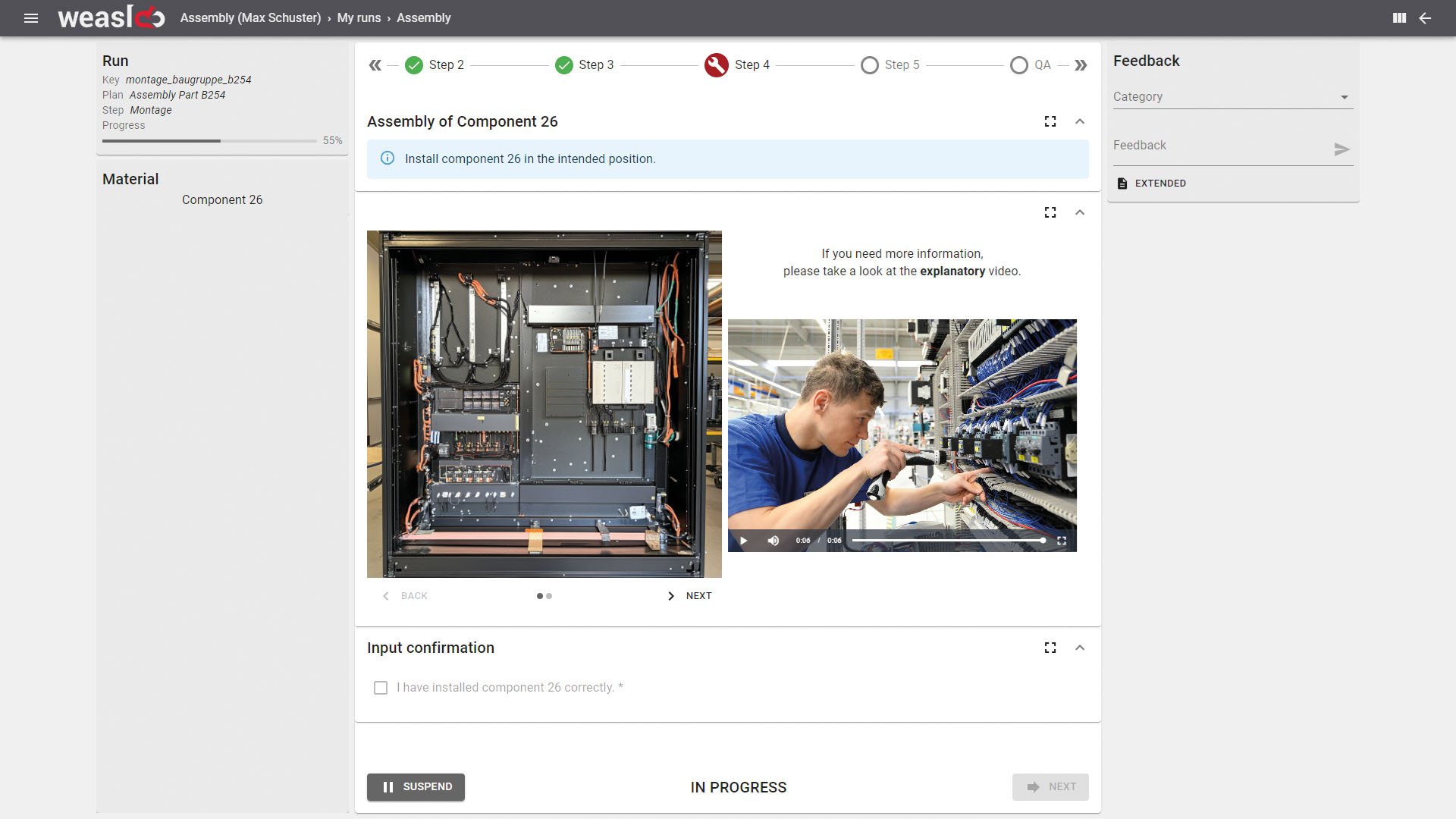
weasl closes the digital gap between your systems and the workers. At its core, the system therefore offers everything you need to make your employees' work easier digitally. At these points, weasl can replace paper-based processes:
- digital step-by-step instructions that can be enriched with media
- provision of design drawings directly in the system, e.g. e-drawings
- provision of work step-related, digital bills of materials
- automatic documentation of each work step
- quick provision of updated instructions
- ensure that your workers are always working with the correct version
Paperless operating instructions
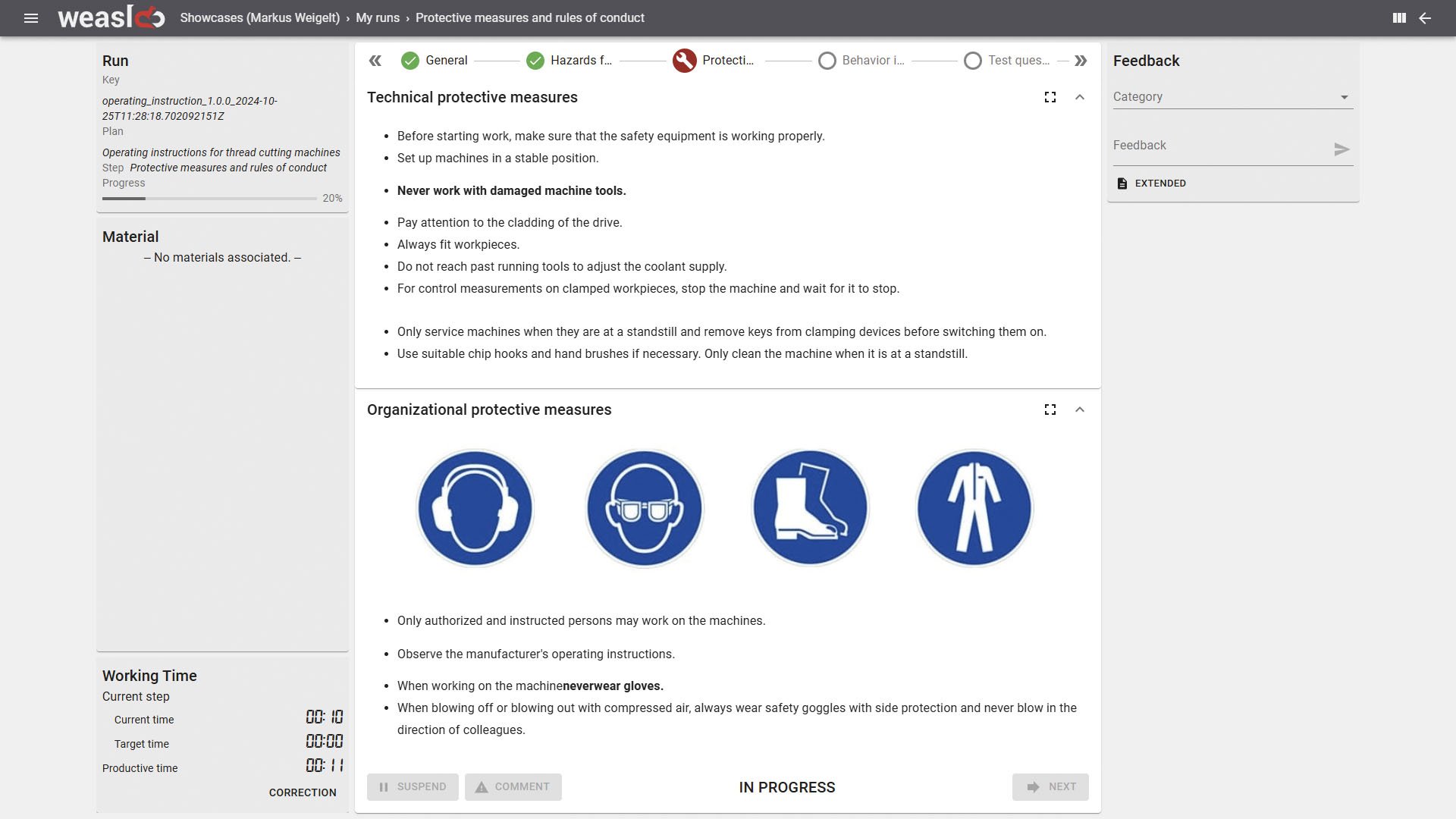
For machine and plant manufacturers, weasl offers further paperless added value: the system can not only support the assembly of the actual machine, but also simplify any final assembly processes for your customers. As part of the EU Machinery Regulation, operating instructions are to be made available to end users digitally from 2027. With weasl, you simply deliver these instructions with the machine. The end user then accesses the operating instructions in weasl digitally via a QR code on the machine, for example.
Paperless shop floor data collection
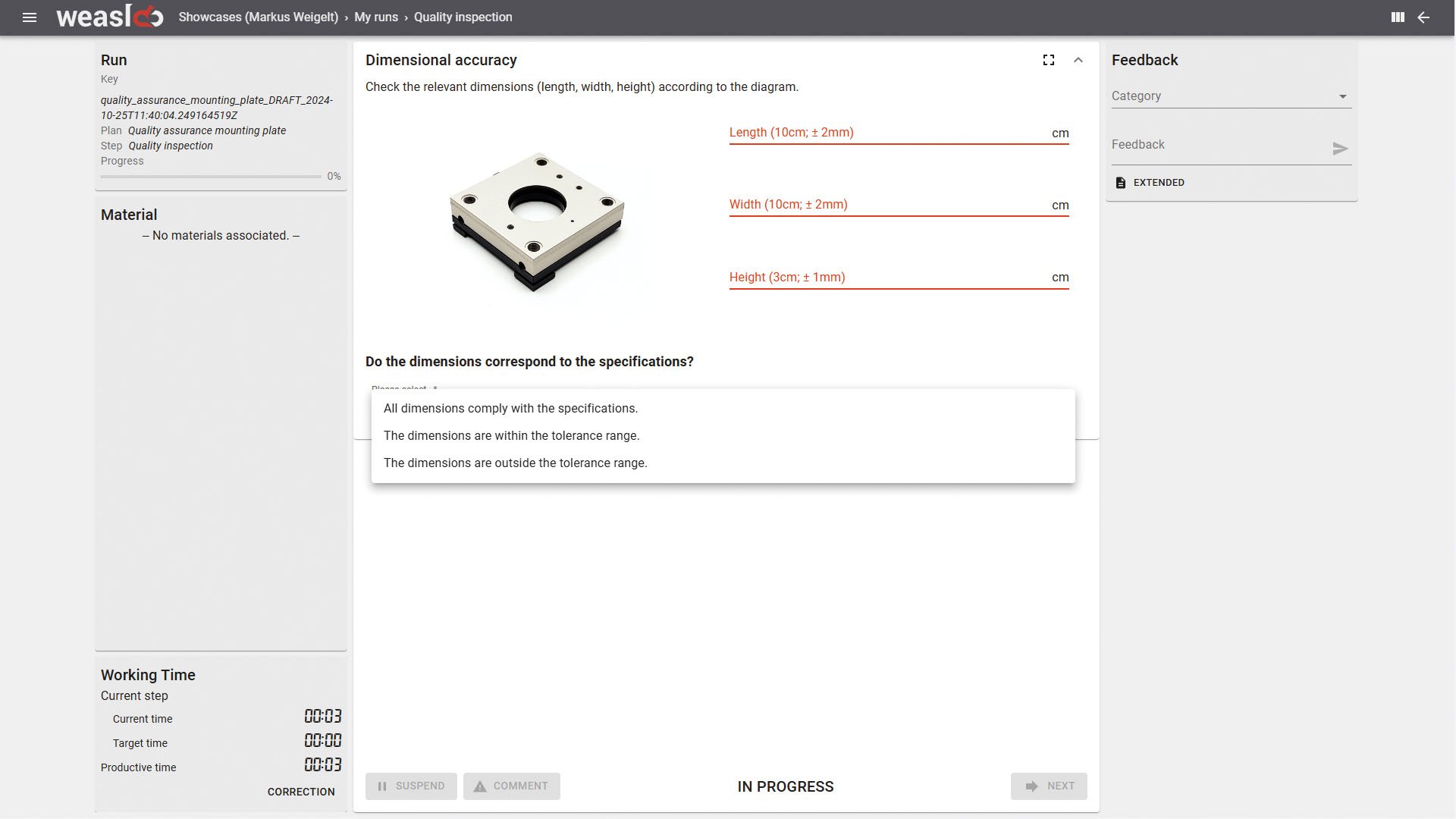
The processing of work orders generates a lot of data that can be recorded directly with a digital system such as weasl and made available for further processing. weasl enables shop floor data collection in the form of:
- quality data, e.g. defect recording / defect class recording
- order data, e.g. productive times
- personnel data, e.g. working times
- material data, e.g. booking of consumption
- etc.
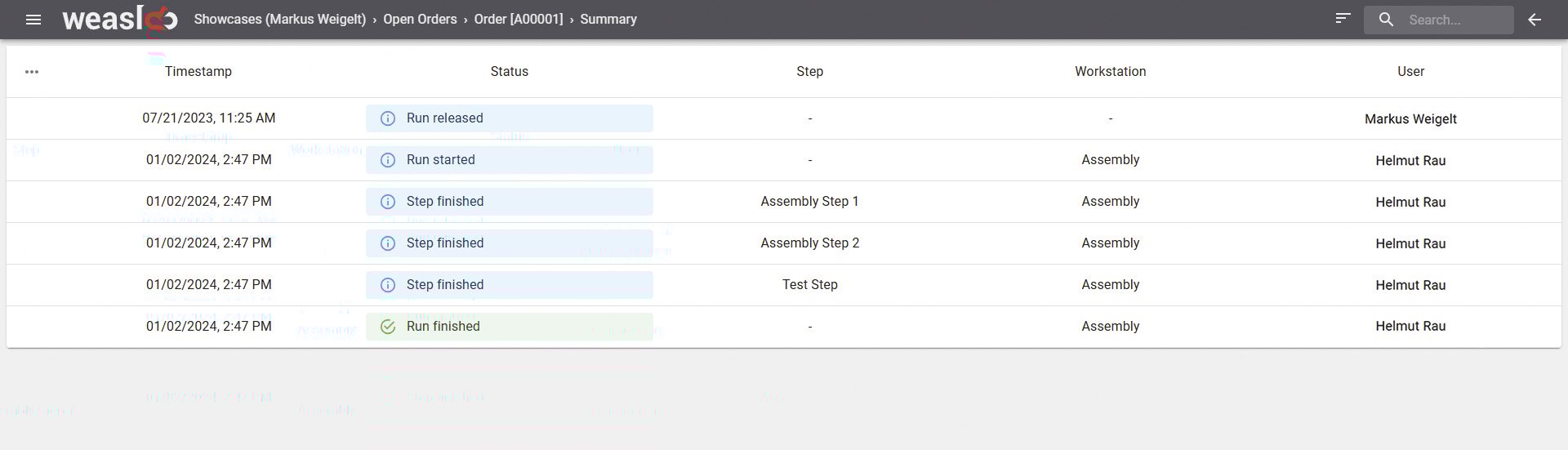
Paperless manfacturing traveler
weasl can also be used as a paperless traveler. The system includes progress monitoring and various mechanisms for tracking and tracing.

André Nimtz has been working in Online Marketing since 2011—bringing a rare combination of technical expertise, linguistic precision, and a dash of wit. His love of writing developed during his childhood, and his style and methodology were honed ...