




Outsmart the shortage of skilled workers in manufacturing —with digital worker assistance
What is experiential knowledge?
"I season by feel." That's exactly the phrase you don't want to hear when you want to recreate a tasty dish. The same applies to processes in everyday work. Only rarely does "I do it by experience" really help. Yet this experience and the corresponding experiential knowledge are the elixir of successful processes.
Experiential knowledge stems from our own practical actions and experiences as well as from adapting to the circumstances. This knowledge is initially always implicit: it is based on the individual experiences of an employee and is difficult to pass on to other people without the same experience. Only explicit knowledge can be formalized, communicated and documented.
Nevertheless, experiential knowledge is invaluable in production and must be safeguarded. To do this, however, implicit knowledge must be converted into explicit knowledge. This is possible if the knowledge recipient can immerse themselves in the world of the knowledge holder through documented instructions and gain the same experience.
Why should experiential knowledge be secured?
Can't it be done without knowledge retention? Perhaps the new colleague will do it differently and even better. Well, let's say the risks clearly outweigh the costs. Especially as there are numerous reasons for safeguarding experience:

In the next few years, around 1/3 of the current employees will retire and with them 1/3 of the experience. Can you do without them?

When experienced employees change companies, they take their experience to the competition, while you lose it.

Knowledge retention can be part of current standards. It has been part of ISO 9001 since 2015.

Experience and therefore knowledge are an important resource and relevant for securing competitiveness.

Secured, processed and up-to-date knowledge is of lasting high value.

With secure and processed knowledge, you can make it easier to deal with changes (e.g. employee departures or the opening of new locations).
Knowledge transfer. Or: The art of using secure knowledge

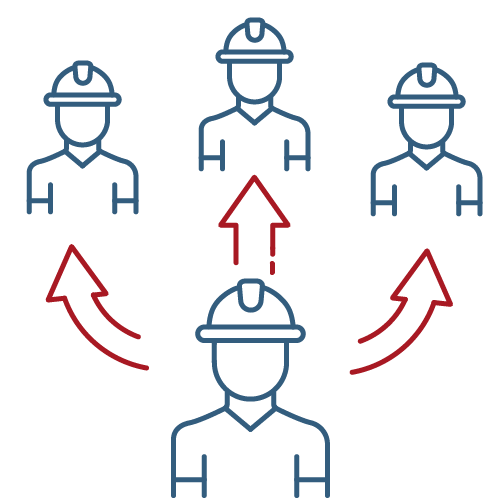
When someone with experience passes on their knowledge to another employee, we speak of knowledge transfer. Passing on and exchanging knowledge based on experience brings the parties involved up to the same level of knowledge. This can happen by chance (e.g. during a conversation at the coffee machine) or in a controlled manner (e.g. during the targeted training of an employee) and is an essential part of knowledge management in the company.
Properly organized knowledge transfer prevents knowledge from simply being archived and becoming obsolete over time. As the knowledge is used to train employees, it remains up-to-date. Each employee can also contribute their own knowledge to the transfer. This gradually creates a diversified pool of knowledge that combines aspects of different experiences. You can draw on this pool to keep productivity and competitiveness high.
How to create a powerful knowledge transfer
Step 1: Identify the knowledge carriers
Where is the valuable experiential knowledge? Who provides the underlying knowledge for a transfer? You can identify the knowledge carriers by talking to managers, supervisors or employees in employee or development meetings.
Step 2: Identify the knowledge areas
Find out where critical and/or unique knowledge lies. This works best with a knowledge map. In this way, you can recognize which knowledge and experience needs to be secured first. Also record the current status: what knowledge is already available, what is still missing?
Step 3: Carry out the knowledge transfer
Now you can pass on targeted and well-founded knowledge to your employees.
Our recommendation: Combine personalized and codified knowledge transfer. We'll take a look at what's behind this in a moment.
Our recommendation: Combine personalized and codified knowledge transfer. We'll take a look at what's behind this in a moment.
Codified knowledge transfer: meaning and methods
"Knowledge means knowing where it is written." This quote by Einstein is a good way to summarize codified knowledge transfer. In principle, it is about recording and documenting the knowledge of the knowledge carriers and passing it on to the knowledge recipients in this documented form. In other words, knowledge is actually written down somewhere.
Let's take a brief look at two methods of codified knowledge transfer.
Method 1: Databases (video, audio, text)
This means
- Recordings of work processes
- Interviews with experienced employees
- Knowledge databases, e-learning, wikis, encyclopedias, etc.
Disadvantages
- Storage location usually outside the systems used on a daily basis
- Continuous access is difficult to guarantee
- High processing and updating costs
- High effort required to prepare knowledge in a way that everyone can understand
Advantages
- Information is maintained by the employees themselves
- Knowledge is saved digitally
- Central collection of knowledge that can be accessed if an employee is absent
Method 2: Worker management
This means
- Digital work instructions for employees
- Always up-to-date step-by-step instructions
Disadvantages
- Initial effort required to digitize existing knowledge
- Knowledge tends to be an implicit part of the instructions
- No actual knowledge database
Advantages
- Employees can feed back feedback / knowledge live
- Fast distribution of instructions
- Experience-based knowledge can be translated into qualification-based instructions
- Training phases are shortened
Personalized knowledge transfer: meaning and methods

"Just talk to each other" would be the summary of the second variant of knowledge transfer - personalized knowledge transfer. Here, knowledge is communicated directly from the knowledge carrier to the knowledge recipient. Sounds simple and efficient, doesn't it? However, personalized knowledge transfer brings with it a number of challenges.
This knowledge transfer requires time and space to be created so that everyone can participate effectively in the transfer. In addition, there is no guarantee that all relevant knowledge carriers and important empirical knowledge are actually involved in the process. Language and / or cultural communication barriers can have a lasting impact on the transfer process, knowledge tends to be passed on selectively and often cannot be stringently reproduced.
Nevertheless, personalized knowledge transfer is often the method of choice due to its variety of methods. Let's take a look at some of the methods.
Method 1: Mixed-age teams
This means
- Cooperation in larger teams, with age groups equally represented
Disadvantages
- Balanced composition necessary, otherwise minority positions arise
Advantages
- Regular exchange on different points of view
- thereby increasing the efficiency of the group
Method 2: Shadowing or learning tandems
This means
- one knowledge bearer and one knowledge taker
- both look over each other's shoulders
Disadvantages
- Two employees sometimes work on the same project / product in parallel
- Knowledge carrier not necessarily trained in training
Advantages
- Different perspectives on the same aspects
- Question and optimize existing routines
- little preparation required
Method 3: Mentoring / mentors
This means
- Mentors with teaching skills give newcomers tasks that they have to complete independently and can ask for help if necessary
Disadvantages
- when working independently, mistakes can creep in that are only corrected too late
Advantages
- Mentor is trained in training and guiding new colleagues
- Promotion of independent learning
- More intensive involvement with the processes
- Access to the mentor's social network
Method 4: Workshops
This means
- Employee workshops / internal training courses in which knowledge is passed on to larger groups of people by trained trainers
- History workshops / lessons learned for understanding why a process is the way it is and how decisions were made
Disadvantages
- Delayed: Knowledge gap is only remedied much later
- Watering can principle: impart as much knowledge as possible to as many people as possible at the same time
- Waste of time: specific / highly specialized questions are not answered and employees only receive knowledge they already have
Advantages
- Establish lifelong learning as a standard in the company
- Past mistakes can be avoided in the future
Method 5: Interviews
This means
- Direct consultation and round of questions with the respective employees
Disadvantages
- Preparation necessary in order to ask specific and targeted questions
- All participants are blocked during the interview
Advantages
- Time in which the focus is specifically and exclusively on the topic
- Targeted questions and scrutiny create insights
Method 6: Coffee break / corridor discussions
This means
- Informal knowledge transfer in the corridor or at the coffee machine
Disadvantages
- Lack of documentation for other colleagues
- Personal filters: What do I remember? And do I remember it correctly?
Advantages
- Informal exchange about everyday problems and challenges
This is just a selection of the methods of personalized knowledge transfer that could easily be expanded through hackathons, barcamps or training within industry. However, three key points stand out when looking at our shortlist:
-
Knowledge transfer starts with such basic everyday activities as a conversation at the coffee machine.
-
There is hardly a company that does not already practice one or other method of personalized knowledge transfer.
-
To turn simple knowledge transfer into a sustainable, lived practice, methods of personalized and codified knowledge transfer should be combined.
The third insight is particularly important. If, for example, you support a mixed-age team with a worker assistance system, the result is a powerful combination for long-term and efficient knowledge retention.
Prerequisites for successful knowledge transfer

You now know some of the most important methods of knowledge transfer and some of them are very simple or already established in the company. Is it still worth putting your current processes to the test? Absolutely. Because only if you have created the right structures and responsibilities will a situational process become a sustainable strategy. For knowledge transfer in your company, this means in concrete terms
1. determine who should manage knowledge in your company.
2. create awareness of knowledge transfer and knowledge management. This includes being open to establishing new routines and consciously doing things differently (change management). This also includes a positive error culture.
3. create incentives for knowledge holders, e.g. by giving them expert status and ensuring that they can stand in when on vacation. A knowledge carrier rarely comes alone.
4. create time and space for knowledge transfer. This ranges from a formal meeting room to a cozy coffee kitchen.
5. identify the learning types in the company and align the methodology or a combination of different methods accordingly.
6. provide the appropriate tools (software and hardware) to secure and transfer knowledge. We recommend a worker assistance system for manual production areas.
7. establish continuous knowledge transfer and knowledge backup as an integral part of daily work. A worker assistance system can also provide very good support here.

Maren Fichtner has been active for weasl since 2020 and has earned a reputation as the voice, heart, and sometimes even the memory of Customer Success Marketing. She makes sure that potential weasl customers feel completely in good hands—from the ...