
Glossary > 5S method

5S Method

weasl author Maren Fichtner
Author: Maren Fichtner | June 16, 2025

Definition: What is the 5S method?

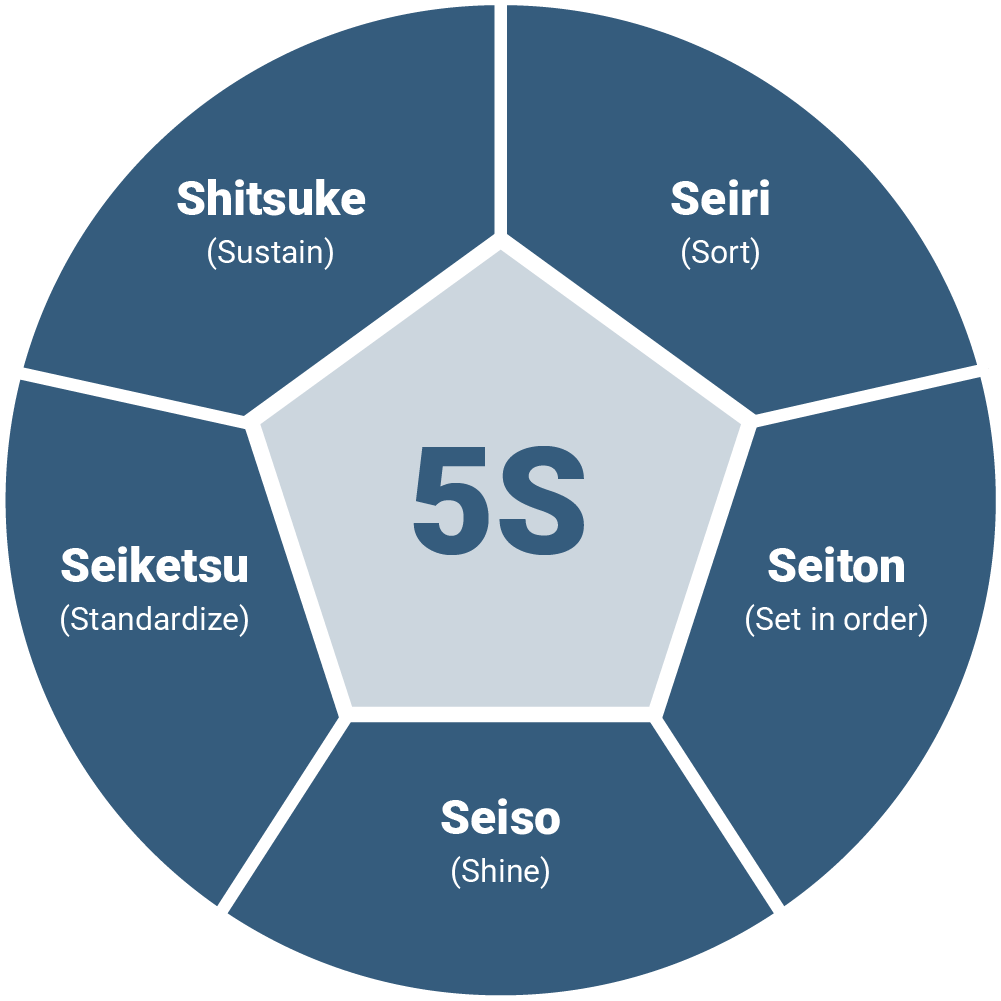
The 5S method - also known as 5S work design - originates from the Japanese Toyota Production System (TPS) and describes the systematic approach to designing a working environment that reduces non-value-adding activities (waste). The 5S build on each other and result in a continuous improvement cycle. The aim is to create safe, clean and clearly organized workplaces and environments.

What is behind these 5S?

The acronym 5S refers - quite simply - to five areas of responsibility or principles that all begin with "S" in Japanese. They are Seiri, Seiton, Seiso, Seiketsu and Shitsuke. And if your Japanese is a little rusty now, we'll be happy to explain what's behind them.

Seiri

Seiri means sorting or sorting out. Applied to production and the workplace, this means that you remove everything that is unnecessary and only keep the things you need in the workplace.

Seiton

Seiton means systematizing, tidying up or creating visible order. When you apply this 5S method, you don't just empty the workplace. Rather, you create fixed, designated places for work equipment - not only from a logistical point of view, but also from an ergonomic one.

Seiso

Seiso stands for cleaning or workplace cleanliness. This simply means that workplaces are regularly cleaned and inspected for defects. And if defects are found, they are of course clearly identified, communicated and rectified.

Seiketsu

Seiketsu is understood to mean standardization or making a given arrangement the rule. Translated, this means that you introduce uniform labels, markings, markings and processes wherever possible and sensible.

Shitsuke

The fifth "S" - Shitsuke - stands for self-discipline, continuous improvement and compliance with and optimization of all points. Established standards should be adhered to and their implementation regularly reviewed - for example in the form of 5S audits. This opens up the possibility for continuous improvement processes.

kw2610_pin-icon

Summary

Seiri (sorting): Sort out what is unnecessary, only what is needed at the workplace

Seiton (organizing): Arrange work equipment systematically and ergonomically

Seiso (cleaning): Clean the workplace regularly, rectify defects

Seiketsu (standardization): Ensuring order through standards / processes

Shitsuke (discipline): maintain, check and improve standards

5S audit checklist as a testing tool

This all sounds sensible and worthwhile, but the 5S method can only work in the long term if the corresponding checks and audits are also carried out. 5S audit checklists have been established for such audits and are intended to support you in the standardized review. They are therefore a tool for evaluating the implementation of 5S in the workplace.

You can use the 5S audit checklist to answer questions such as:

  • Are only necessary items present in the workplace?

  • Have superfluous materials been removed?

  • Is the distinction between necessary/unnecessary clearly recognizable?

  • Does every item have a fixed, marked place?

  • Are all tools and materials easy to find?

  • Are storage positions labeled and visualized?

  • Is the workplace clean and tidy?

  • Are regular cleaning cycles adhered to?

  • Are cleaning responsibilities defined?

  • Are there uniform standards for all workstations?

  • Are the 5S rules consistently followed?

  • Are work instructions available and up to date?

  • Is 5S practiced independently?

  • Do regular audits take place?

  • Are suggestions for improvement implemented?

Depending on the requirements and circumstances of your company, you can expand or shorten this list of questions and adapt it to your specific needs. This will ensure that 5S is not just a buzzword for the lean production you are aiming for, but that it becomes a lived practice.

kw2610_pin-icon

Summary

Evaluation tool for the systematic review of 5S implementation

Checklist with specific questions on all five "S "s

Content flexibly expandable and customizable according to company requirements

Advantages of the 5S method

With standardization and the elimination of disruptive workplace elements, you have already seen two powerful arguments for the 5S method. But between the lines, you have probably already recognized that 5S can bring many more advantages. These include

  • trouble-free and efficient work processes

  • the avoidance of search times, long transportation routes and waiting times

  • significant time savings at work

  • a system that is easy to understand and implement

  • sensitizing employees to order and efficiency

  • Promoting standardized and routine work processes

  • creating a basis for continuous improvement through regular reviews

kw2610_pin-icon

Summary

Increased efficiency: fewer search times, shorter distances, faster processes

Standardization: clear structures and routines for greater process reliability

Employee involvement for more order, personal responsibility and improvement thinking

Disadvantages of the 5S method

So the 5S method makes everything better and doesn't involve any risks? Well, that would be too good. Of course, 5S also has points of criticism. For example, it harbours the risk of over-formalization. If processes, workplaces and the like are formalized too much, everyday work can become unnecessarily complicated.

In addition, 5S is not a preventative measure. In many cases, you do not use it to eliminate fundamental problems, you simply use the 5S method to react to problems that have arisen and resolve them.

What's more, not everything in your company or production can be standardized using the 5S method. There will always be areas where you need other approaches.

And what about the inner bastard? Strictly speaking, you can structure and tidy up a workplace however well you like. Ultimately, no one will stop your employees from breaking this order and carrying on as before. For the 5S method to be successful in the long term, it requires a lot of self-discipline.

Last but not least: The 5S method itself does not add value. Although you are concerned with optimizing workplaces and processes, this does not necessarily lead to an increase in your added value.

kw2610_pin-icon

Summary

Over-formalization: too many rules can make processes unnecessarily complicated

5S often reacts to symptoms, not to underlying problems

Not all areas can be meaningfully standardized with 5S

Without discipline and personal responsibility on the part of employees, there is no effect
Standardize production processes & audits easily

weasl product flyer

Standardization comes before optimization. Or rather, it is the first step towards a sustainable improvement of your value-adding processes. A digital system like weasl can make a valuable contribution to this.


Find out what weasl can do for your company and get our detailed product flyer.