With weasl, VACOM creates a digital working environment that provides detailed step-by-step instructions, enables automatic logging, identifies the causes of errors and ensures end-to-end traceability.
VACOM Vakuum Komponenten & Messtechnik GmbH
Industry: Vacuum & measurement technology
Company headquarters: Großlöbichau, Thuringia
Employees: approx. 450
Founded: 1992
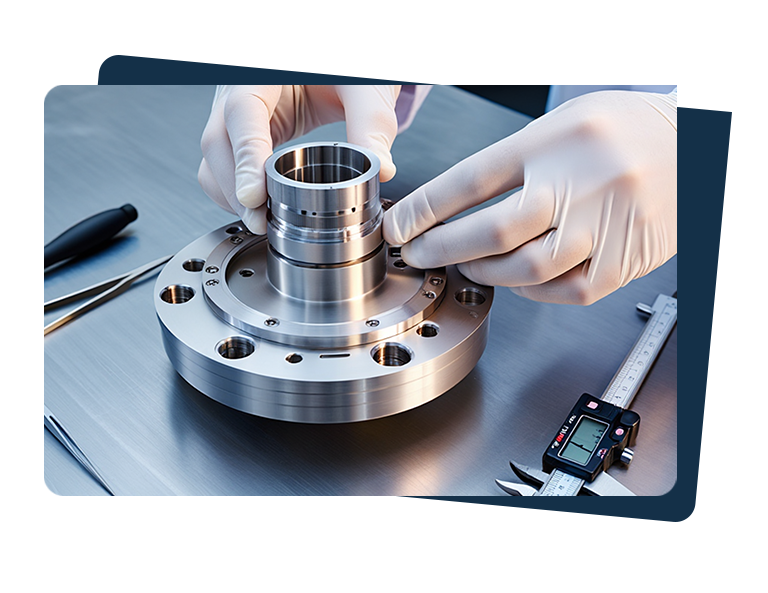
VACOM GmbH is one of Europe's leading manufacturers of vacuum technology. The company develops and manufactures high-quality components, for example for the semiconductor industry, analytical technology, research and aerospace - with state-of-the-art production processes, certified clean rooms and the highest quality standards.
VACOM relies on resource-efficient processes, renewable energies and certified environmental management. In this way, the company combines high-tech manufacturing with sustainability in practice. With sites in Germany, Belgium and the USA, VACOM has an international presence and is a reliable partner for sophisticated vacuum solutions.
The assembly of components and parts is an integral part of VACOM's day-to-day business. To carry out an assembly order, the workers currently go into SAP. There they find a work plan and a corresponding assembly workstation. Drawings, all of which have a similar structure, form the information basis for the implementation of the order. SAP provides the worker with the instruction "Assembly according to drawing".
For the worker, this instruction leaves a lot of room for interpretation; there is no real worker guidance along the individual assembly steps. The orders are processed according to the experience of the worker and the interpretation of the respective drawing. He receives no further support from SAP. They can only report their orders and the quantities produced. This requires a great deal of prior knowledge and interpretation on the part of the employee, slows down processes and easily leads to errors.
"'Assembly by drawing' can mean anything and contains a lot of room for interpretation. We wanted to take this to a new level."
Patrick Krebs

VACOM's primary goal was to replace the rigid and error-prone SAP process of "assembly by drawing" with a more efficient solution. In future, workers should be guided through their assembly processes in detail and no longer be confronted or even overwhelmed with a great deal of room for interpretation.

VACOM sees another goal in the digital logging of all work. Workers should be able to document all activities carried out without additional effort and report problems in the process as easily as possible. The generated log is to be fed back into SAP and make production processes transparent for the customer.

Defective products naturally go into rework at VACOM. However, the causes of the faults have not yet been recorded and therefore could not be rectified immediately. In future, VACOM would like to identify the causes of errors and n.i.O. processes directly and rectify any problems that arise more quickly.

VACOM wants to establish end-to-end traceability based on the collected data and stored logs. In the event of a complaint, for example, it should be possible to make transparent where errors occurred.

The work at VACOM takes place in a clean room. Accordingly, the company was looking for an end-to-end digital solution that could solve as many of the identified challenges as possible.
The search for a solution was based on key criteria: In addition to the variety of functions that would make it possible to achieve the intended goals, VACOM kept an eye on technological aspects in particular. The company works with Hydra-X, the MES from MPDV. In order to establish a seamlessly integrated system, VACOM therefore looked for solutions that work on MPDV's Manufacturing Integration Platform (MIP).
In the course of their research, the VACOM project team finally came across our connected worker platform weasl, which we can seamlessly integrate into the MPDV ecosystem as a MIP partner and have already successfully integrated for other companies. For VACOM, weasl offered the desired features and the necessary flexibility to tackle a pilot project to optimize the assembly processes.
The existing Hydra-X MES will be supplemented by weasl and linked to it via an interface so that the workers will work exclusively in weasl in future. The connected worker platform runs on a second monitor and is operated by touch. Authentication is carried out using a smart tag.
The aim is to minimize additional work for the workers. Instead of maintaining data and content in weasl and Hydra-X, this is done by the connected worker platform. Everything that the worker enters in weasl is passed on to Hydra-X via an interface. From here, the data is then transferred to SAP.
In the first step, this requires detailed mapping of the data in the various systems. weasl can be granularly adapted to the company's domain and thus ensure that orders and order-relevant data are correctly transferred or returned from the leading systems.
Production preparation can work with this data to prepare all assembly scenarios for weasl. The annotated drawing thus becomes a detailed process instruction that shows the worker step by step how to manufacture a component. If the worker is to be shown relevant information at certain steps - for example on screw-in depths, torques or sensitive assembly steps - weasl can retrieve this information from SAP via MIP and display it precisely at the relevant step. Conversely, weasl transmits data back from production - for example, whether it is a component requiring a serial number, whether there are OK/NOK parts or whether and why problems have occurred.
weasl brings the necessary flexibility into play when executing the assembly processes. The system can specify different processing paths - depending on whether a component requires a serial number or not, for example. If it requires a serial number, weasl only allows the worker to process it step-by-step. Otherwise, he decides for himself whether he wants to process several components in parallel.
"It should be as simple as possible for the workers. They should be able to see all the information where they need it, so that they can't really do anything wrong. That's exactly what weasl makes possible."
Patrick Krebs
With weasl, VACOM turns annotated drawings into digital step-by-step work instructions that guide employees safely through the processes. Workers receive the information they need exactly where they need it. Scope for interpretation is eliminated and the risk of errors is minimized. In addition, the responsible fitter no longer necessarily needs to have extensive prior knowledge in order to carry out a job correctly. weasl explains each step in detail so that even inexperienced workers can be deployed.
During assembly, weasl records data and work progress and plays it back to connected systems. This creates a database that makes basic evaluations and analyses possible. Causes of rework can be analyzed and rectified. End-to-end traceability enables well-founded complaints management. This benefits the company and, not least, its customers.
Following the assembly pilot project, VACOM can already imagine further application scenarios for weasl. One obvious scenario already resonates in assembly: quality assurance. Here, weasl can provide support for worker self-inspection, quality controls and strategic quality assurance.
The project team also sees potential for the use of weasl in technical building management. Here, weasl could be used on tablets and support maintenance work or facilitate the corresponding documentation work.
The team sees another realistic scenario in the connection of tools via the MIP. In this way, process data could be recorded directly from the connected tools or even output to them. weasl definitely offers potential and the corresponding flexibility to master cross-departmental scenarios.
With our connected worker platform weasl, you create the basis for the sustainable optimization of manual production and assembly processes.
Democratize the expertise in your production.
Create transparency in your production processes
Integrate digitized workflows seamlessly into your value chain.