





Outsmart the shortage of skilled workers in manufacturing —with digital worker assistance
Why is knowledge retention important for manufacturing companies?
Knowledge secures the competitiveness of companies. Alongside land, labor and capital, it is one of the most important production factors. In many companies, knowledge now accounts for the largest share of total value added. Experts estimate this share at around 60 percent. Securing knowledge should therefore be seen as a fundamental, permanent task.
When is knowledge retention particularly relevant?
Knowledge retention becomes particularly relevant when experienced employees leave the company due to age or a change of job. Companies run the risk of losing assembly, quality inspection and maintenance knowledge that has been built up over the years. If successors are also left to their own devices when it comes to training, good advice is expensive. Knowledge retention and knowledge transfer are therefore relevant for every manufacturing company.

What dangers exist if knowledge is not transferred and secured within the company?
- Required knowledge is difficult to access. This slows down the work process and reduces productivity
- Knowledge is not used adequately because the people involved are not aware of its potential.
- There is a lack of motivation to share knowledge.
- Knowledge is lost.
How can knowledge be easily transferred and secured in assembly, quality inspection and maintenance?
A digital worker assistance system such as weasl enables employees on the store floor to easily store and use performance-relevant information digitally. It supports and promotes the structured transfer of knowledge from knowledge carriers to knowledge recipients. The knowledge is available regardless of personnel changes and is documented in an up-to-date, comprehensible and traceable manner.
How does weasl improve knowledge transfer during ongoing production operations?
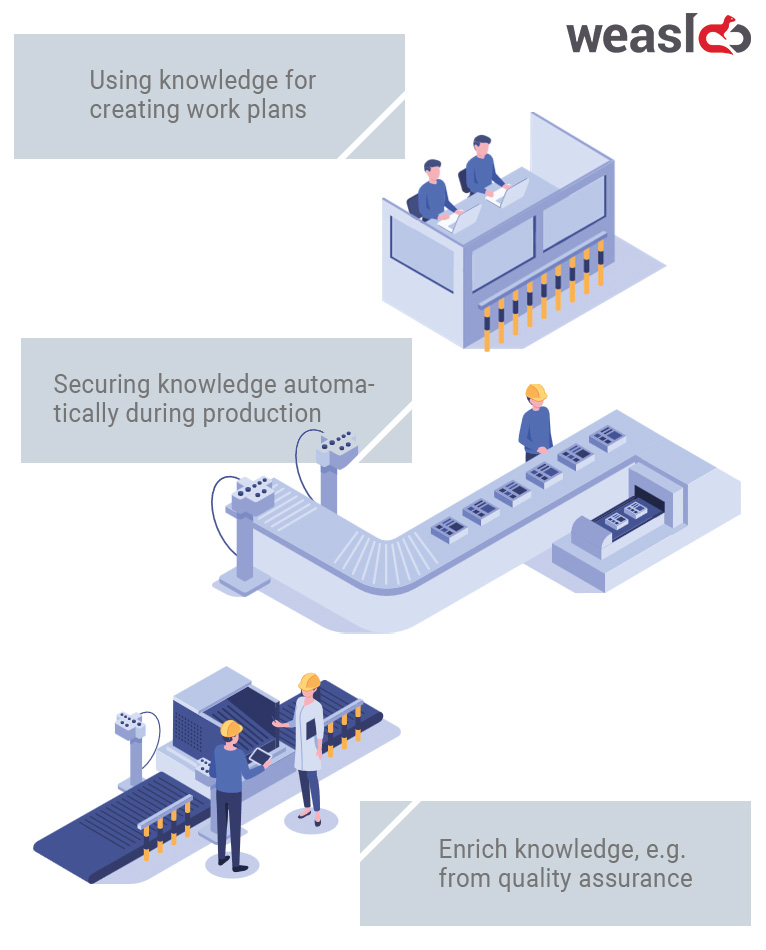
With the help of the weasl worker assistance system, work processes are described in digital work instructions. The advantage: employees' implicit knowledge, such as experience and knowledge of procedures, is also recorded and flows directly into the description process. Production managers can take execution information into account when making future decisions and design work processes more efficiently. Knowledge is saved, updated and made available in one system. Thanks to the feedback mechanisms, disruptions in the workflow are communicated more quickly. Production managers can react quickly or assign someone to find the cause. In addition, information on production progress, deviations from plan or causes of errors can be passed on to the next shift, production management or sales.

Maren Fichtner has been active for weasl since 2020 and has earned a reputation as the voice, heart, and sometimes even the memory of Customer Success Marketing. She makes sure that potential weasl customers feel completely in good hands—from the ...