





Capture Experiential Knowledge and Make it Available for Knowledge Transfer
Increase availability, relieve employees
The bad news first: the shortage of skilled workers in production will continue to worsen. The good news is that there are digital worker assistance systems for technical and manual tasks in assembly, commissioning and maintenance that companies can use to increase their staff availability and relieve the existing workforce of work pressure.
The support provided by digital worker assistance opens up greater freedom of action when deploying personnel. Companies benefit from this in two ways.
Advantage #1 - Inexperienced/unskilled workers can be deployed more quickly
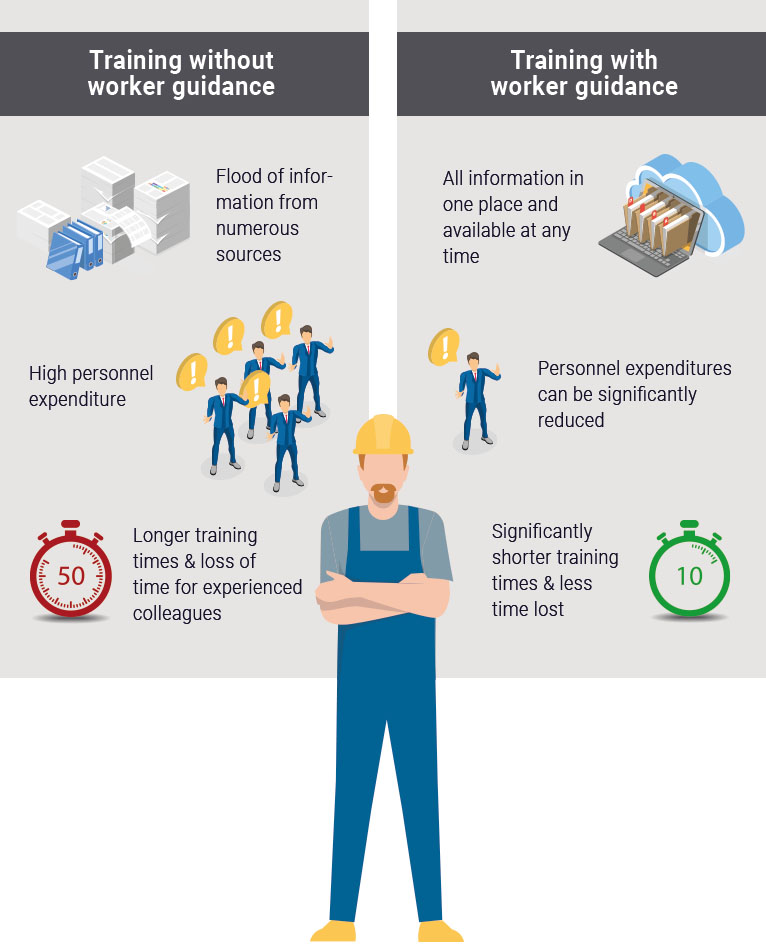
Experience shows that inexperienced and unskilled employees are able to perform tasks independently and correctly much faster when they are supported by a worker assistance system.
From their first day at work, employees are confronted with a wealth of information. Every company has different work processes and terminology. In addition, the employee has to get to know and understand the new work steps. The faster the employee learns the tasks to be carried out and the less support they need from experienced colleagues, the lower the loss of productivity for the company.
A worker assistance system provides support through detailed step-by-step instructions and clear illustrations in text and images. The assistant is available at all times and offers the employee varying degrees of assistance as they progress through the induction process. This gives the employee security, creates trust and relieves the more experienced staff.
The positive effect for companies: With the support of a worker assistance system, unskilled staff can be deployed in greater numbers and staff shortages can be compensated for more easily.
Advantage #2 - Employees can be deployed more flexibly
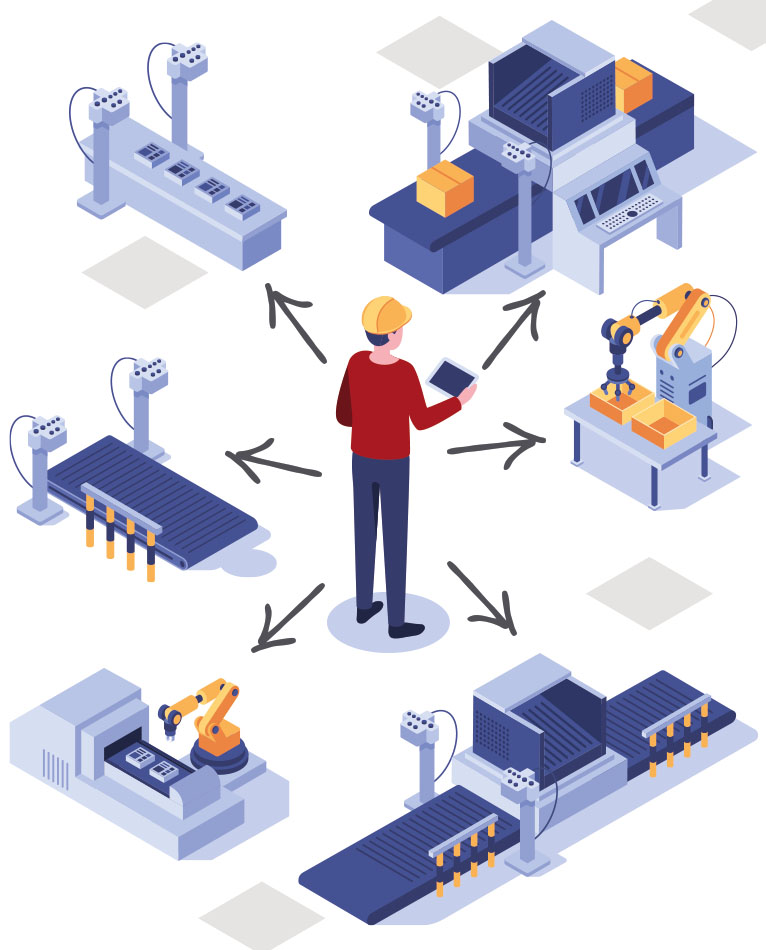
It is not only inexperienced workers who are required to perform unfamiliar tasks. Experienced specialists also need support and training time when they have to carry out new tasks.
Let's take a practical look at a customer example from the switch cabinet construction industry: here, products are manufactured to customer specifications from several thousand assemblies with over 20,000 individual parts. The assembly process consists of up to one hundred work steps that correspond to the desired individual product specification.
With the help of the digital assistant, the fitter can complete his work steps quickly and in accordance with the specifications. The worker assistance system guides him step by step through the assembly plan, provides information on the bills of materials and CAD drawings and tells him what needs to be done in detail. Stored checkpoints ensure that the work steps are carried out reliably.
With the worker assistance system, the fitter is immediately able to carry out even unfamiliar work steps efficiently and without errors. This in turn enables the company to deploy its employees flexibly and without a long training period at different workstations, both in the event of increased order volumes and staff shortages (e.g. due to illness).

André Nimtz has been working in Online Marketing since 2011—bringing a rare combination of technical expertise, linguistic precision, and a dash of wit. His love of writing developed during his childhood, and his style and methodology were honed ...