Glossary > ERP - Enterprise Resource Planning
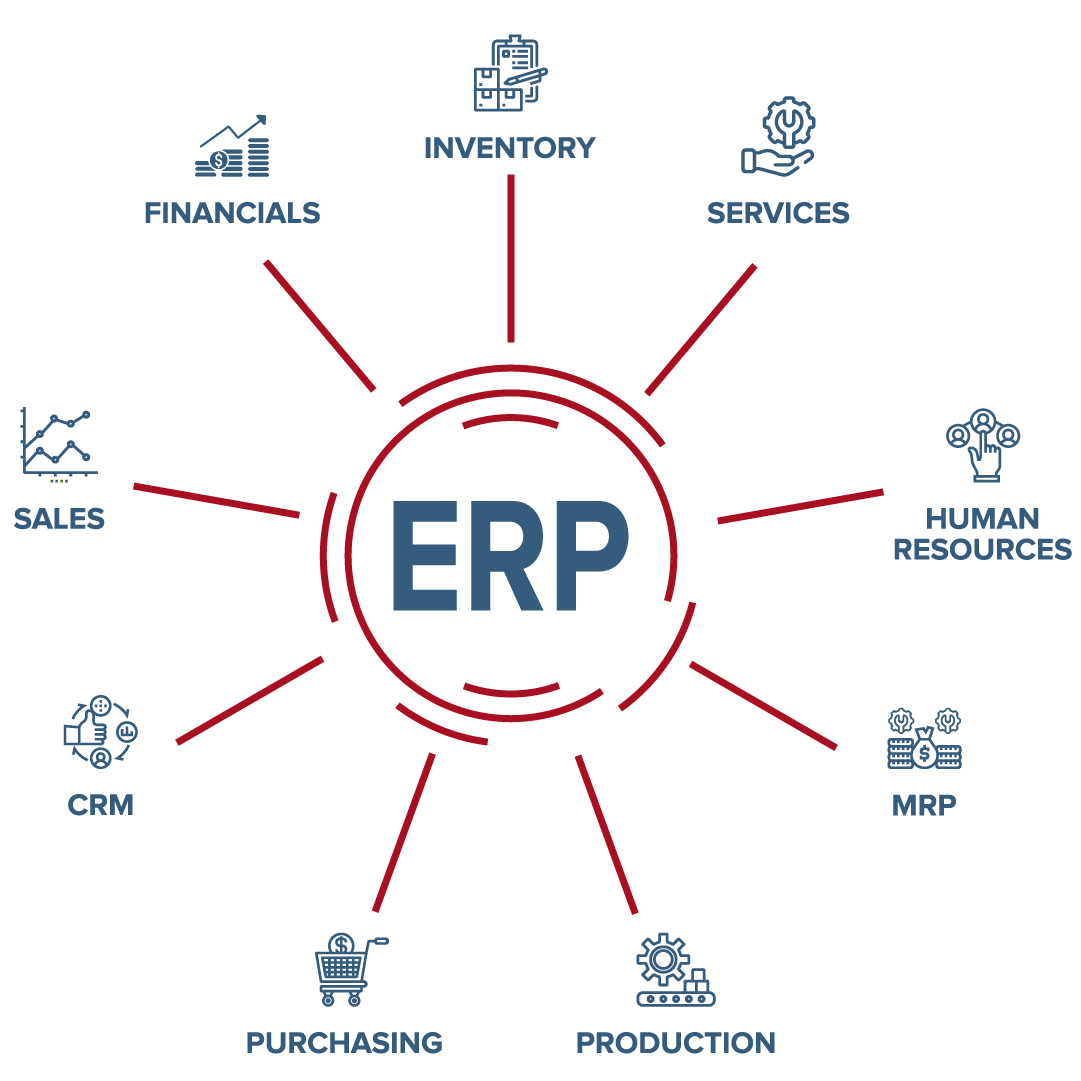
ERP is the abbreviation for Enterprise Resource Planning. An ERP system is centralized software that connects and manages all important business activities - from procurement and production to accounting and supply chain management. Even HR and sales can be connected to an ERP.
At its core, an ERP has the task of planning, controlling and managing company resources - such as capital, materials, operating resources and personnel - in line with requirements. This helps companies to provide up-to-date information across departments, reduce barriers to collaboration and make informed decisions.
The introduction of an ERP in your company is basically the same as the introduction of any other standard system.
Of course, you must first have the need to establish cross-company resource planning. Are there always obstacles to cooperation? Do material flows stall? Is there no data transparency? Then these are good signs that an ERP would make sense.
Once you have identified the need, gather the requirements for the system from the relevant departments and write them down. As soon as you have an insight into what you need, start researching providers and creating a shortlist. Once you have found your favorites, talk to the providers and test the solutions.
Once you have found the right solutions, start with the implementation. But be careful: Don't introduce the new system everywhere straight away and overwhelm your employees. Start with a test balloon in an area that will help you directly and provide you with lots of insights. If everything fits, nothing stands in the way of a company-wide roll-out.
In detail, an ERP offers countless advantages - as do most other digital systems. We want to focus on two major benefits here:
1. improved collaboration
The ERP is your central system with information on a wide range of business processes that can be used across departments. This results in significantly increased transparency in the company across many departments. Data and information become widely usable and collaboration is sustainably optimized.
2. improved business data
With an ERP, you eliminate data silos in your company and establish a central system for data collection and dissemination in uniform standards. On the one hand, this creates an improved data basis and also better opportunities to work with the existing data.
The core of an ERP system is material requirements planning or manufacturing resources planning. With this core functionality, you ensure that all required materials are provided at the right time and in the right place for production.
ERP systems provide numerous other functions around this core function. These include, for example
Materials management
Finance and accounting
controlling
Sales and purchasing
Master data management
Not every ERP has all these functions. Depending on the industry, you can also find specialized ERP solutions or supplement standard software with the required modules.
Industry-specific ERP systems are also quite common on the market today. An example of this would be Sage Wincarat, which offers individual elements and functions specifically for the plastics industry.
We don't want to write an endlessly long list of further terms. Nevertheless, there are two terms that keep cropping up in the ERP environment.
Enterprise Performance Management (EPM) is often used as a synonym for ERP. However, it is more a case of supplementing the standard ERP functionalities with
performance monitoring
the creation of budget plans
forecasts/forecasts
Financial reports for operational planning (strategy)
You will also come across financial planning as an ERP system again and again during your research. Strictly speaking, however, this is not an ERP system, but merely a component of an ERP that focuses on the tasks of the finance department (e.g. accounting, invoicing, reporting).
As a global system in a company, an ERP can also be assigned global objectives. At its core, an ERP should make the value creation process more efficient. However, the optimization of internal processes and procedures to increase the competitiveness of your company can also be counted among the goals of an ERP system.
Our Connected Worker platform weasl works with data from your connected peripheral systems and can play back recorded data. Use the data from your ERP in work instructions in weasl and create even more consistency and transparency.
Find out what weasl can do for your company and download our detailed product flyer.