
Glossary > Document control

Document Control

weasl author Maren Fichtner
Author: Maren Fichtner | June 16, 2025

Definition: What does document control mean?

Document control is a basic principle of quality management and refers to the systematic management and control of documents throughout their entire life cycle.

This life cycle includes

  • the creation of documents

  • editing (i.e. changes and updates)

  • review and approval

  • the release of documents

  • Automatic distribution to the right recipients

  • the audit-proof archiving of all information

  • and the destruction of documents

Document control is also of central importance in ISO 9001. This is referred to as the control of documented information. In the course of ISO 9001, certified companies must manage and secure an increasing amount of documentation. In this context, sound document control is becoming increasingly important.

kw2610_pin-icon

Summary

Document control regulates the creation, checking, approval and archiving of documents

ensures that information is up-to-date, controlled and traceable

Central element in quality management according to ISO 9001
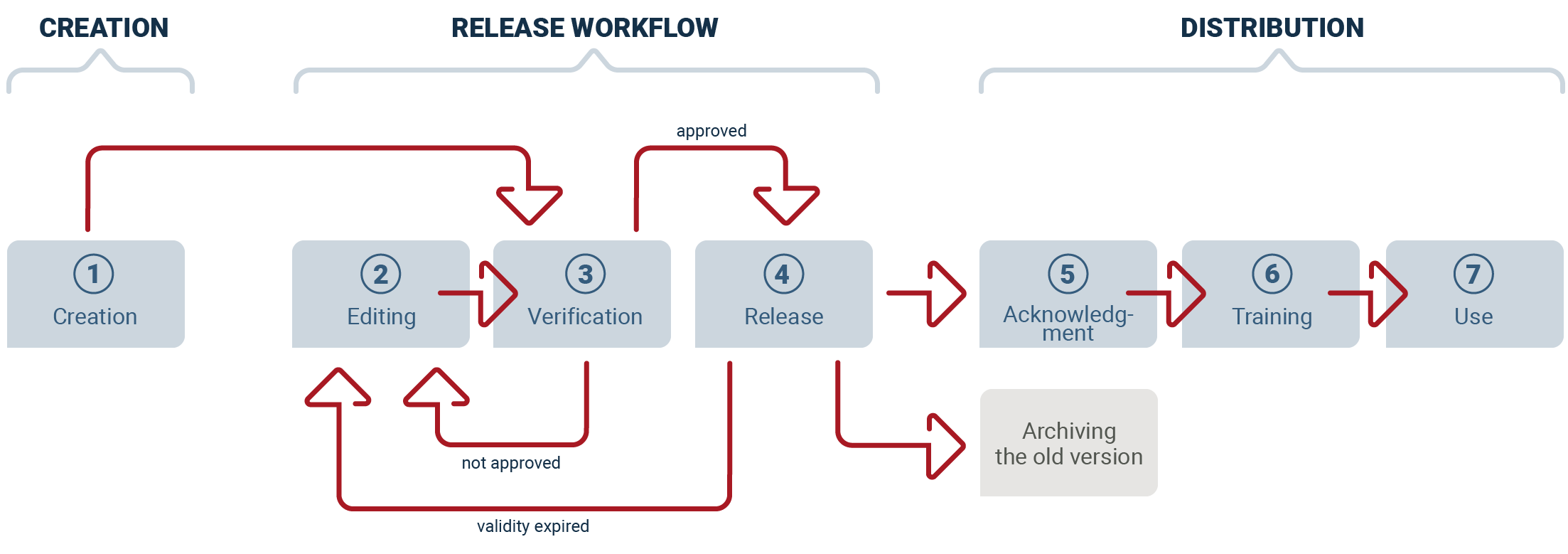
The three basic phases of document control

A document must pass through certain phases in order to be considered controlled. To a certain extent, they are based on the life cycle of the document.

1. creation

First, the document must be created. To turn this unguided document into a guided document, it must not disappear into the file repository or a folder, but must move on to the next process step - approval. A basic set of formal information must be available in the document. This includes

  • the version number

  • the author

  • and the date of creation

2. release workflow

During release, the document is checked and released or returned for revision. The release workflow basically consists of the editing, review and release stages and can be run through several times. If the document does not pass the check, it is returned to the editing stage - until it can be released.

The released document contains further formal information that makes the process traceable. This includes

  • the new version number

  • the editor

  • the person checking the document

  • the releasing person

  • the date of the changes

  • the release validity

3. distribution

Once the document has been approved, it can be distributed. In this phase, however, control means that it is not simply distributed to employees. Here too, transparency must be created regarding the handling of the document.

Recipients of the document confirm that they have read and received the document. Depending on the scope and importance of the document, the affected interest groups should be trained to use the new document safely.

At the same time, the invalidated document version is removed from circulation and archived, including the document history.

kw2610_pin-icon

Summary

1st phase: Document is created with formal basic information

2nd phase: Document undergoes (possibly multiple) processing, review and approval

3rd phase: Document is distributed, acknowledgement documented, old versions archived

The advantages of document control

If you take a pessimistic view of document control, you could say that document control generates a lot of work, ties up resources and requires a watertight archiving strategy. Of course, there is something to that. But in return, document control brings invaluable advantages that more than make up for the disadvantages:

  • With established document control processes, you ensure efficient workflows and high process and product quality.

  • Document control turns simple documents into consistent, valid and up-to-date information.

  • Employees gain quick and easy access to relevant documents with effectively implemented document control.

  • Checking and updating routines allow you to secure knowledge and pass it on efficiently within the company.

  • You create traceable documentation of changes, approvals and versions, thereby improving traceability and transparency.

  • Managed documents are worth their weight in gold when it comes to compliance requirements or audits and certifications.

  • By controlling documents, you ensure compliance with legal requirements, industry-specific standards and quality specifications.

kw2610_pin-icon

Summary

Efficient processes and high quality thanks to clear document control

Accessibility and transparency, as employees always have access to up-to-date, verified documents

Secure compliance thanks to traceable version statuses, releases and archiving

Which documents can be controlled and which cannot?

Document routing works both on paper and digitally. But it does not work with all documents. Good examples of documents that can be controlled within a company are

  • Email templates in sales

  • Work instructions in production

  • Operating instructions for machines

  • Guidelines for occupational health and safety

These are all documents that are intended to provide guidance or control things. The cycle of creation, release, versioning and archiving makes perfect sense here.

On the other hand, document control is not feasible for documents that arise from events. An error report or meeting minutes cannot and must not be changed after they have been created.

A good example can also be found in the ISO 13485 quality management standard for medical device manufacturers. Here, an explicit distinction is made between documents and records. Protocols or test reports are therefore records that cannot be subsequently revised and therefore cannot be controlled. However, new instruction documents can be derived from test reports, which in turn can be controlled.

kw2610_pin-icon

Summary

controllable documents are instructional documents such as work instructions

Non-controllable documents are logs or reports that may not be changed

ISO 13485 distinguishes between documents and records
Objectives of document control

Fundamentally, document control is intended to optimize the handling of your documents in terms of quality management. To this end, it ensures the orderly management and targeted control of all relevant documents.

It also makes it possible to provide the right information to the right people at the right time.

Create & manage digital work instructions easily

weasl product flyer

Digital work instructions are the ideal basis for your workers and fitters to work efficiently and error-free. They are also documents that you can manage in a targeted manner, adapt as required and document in an audit-proof manner - ideally with our Connected Worker platform weasl.

Find out what weasl can do for your company and download our detailed product flyer.