Glossary > EN ISO 12100
EN ISO 12100 is a fundamental safety standard for mechanical engineering that establishes a generally applicable methodology for risk assessment and risk reduction in machinery. As a so-called Type A standard, it forms the methodological foundation upon which nearly all more specific machine safety standards are based and serves as key evidence of compliance with the essential safety requirements of the EU Machinery Directive.
Publisher: International Organization for Standardization (ISO)
Current edition: DIN EN ISO 12100:2011-03
The standard is intended for designers and manufacturers of all types of machinery – from individual machine builders to manufacturers of complex production lines. It is applicable across all industries, regardless of whether the machinery in question is machine tools, packaging equipment, robotics, or custom-built machinery, and provides the methodological basis for any conformity assessment within the framework of CE marking.
Define the machine’s limits: intended use, foreseeable misuse, life cycles
Identify hazards: systematic identification of mechanical, electrical, thermal, and other hazards
Assess and evaluate risks: evaluation based on the severity of potential harm and the probability of occurrence
Three-step method: prioritize intrinsically safe design, followed by technical protective measures, and finally user information
Documentation: complete record of the risk assessment as part of the technical documentation
Iterative process: repeated implementation until the residual risk is deemed acceptable
The EU Machinery Regulation (2023/1230) defines the legal requirements a machine must meet in order to be placed on the market in the EU. It is the overarching legal framework. EN ISO 12100, on the other hand, provides the specific, technical methodology by which manufacturers can demonstrably meet these requirements in practice: Anyone who correctly performs and documents the risk assessment in accordance with EN ISO 12100 can invoke the presumption of conformity with the essential safety requirements of the Regulation. The Regulation and the standard are thus directly interlinked: Without a robust risk assessment in accordance with EN ISO 12100, it is virtually impossible in practice to justify the CE marking under the Machinery Regulation with legal certainty.
A missing or incomplete risk assessment undermines the presumption of conformity and, thus, the basis for CE marking. In the event of damage, it regularly becomes the central point of scrutiny in product liability cases. Market surveillance authorities may prohibit the sale of the machine if there are identifiable deficiencies in the risk assessment; in the event of actual accidents, manufacturers and responsible designers also face civil and criminal consequences.
EU Machinery Regulation (2023/1230) – legal basis for placing Machinery on the market
ISO 9001 – basic quality management standard
EN 1090 – execution of steel and aluminum structural works
IATF 16949 – quality management system for the automotive industry
Not directly, but as a harmonized standard, it is effectively the standard path to a presumption of conformity with the Machinery Directive.
Type A, as defined in EN ISO 12100, establishes the general methodology; Type B addresses specific safety aspects; and Type C governs specific types of machinery and takes precedence in the event of a conflict.
First, intrinsically safe design; second, technical safeguards; and finally, user information – in that specific order.
The manufacturer itself, through trained personnel, except in the case of high-risk machinery, where the involvement of a notified body is required.
The greatest effort is required to update them throughout the entire product lifecycle – for example, following design changes or new insights from the field. Connected worker platforms like weasl link work and inspection instructions directly to the underlying risk assessment and ensure that safety-related steps in the manufacturing process are consistently followed and fully documented.
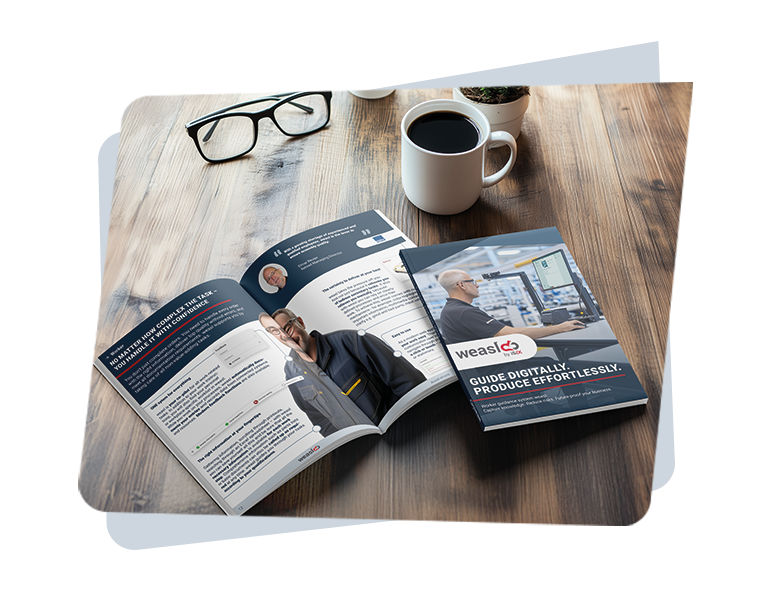
Learn more about weasl and request our product brochure now.
COMPANY
RESOURCES
GET IN TOUCH